

How international movers can close the B2B-to-B2C talent gap and build the skills the lumpsum era demands
The lumpsum transition is changing more than who pays for an international move. It is changing the capabilities moving companies need to compete for that move.
For decades, the industry's commercial model was built around institutional relationships. Winning meant securing corporate accounts, responding to RFPs, and maintaining long-term relationships.
Under a lumpsum model, the individual transferee increasingly becomes the buyer: discovering providers online, comparing options, weighing reviews and pricing, and making a decision within days or weeks.
That does not make the industry's traditional talent base obsolete. It makes it incomplete.
The emerging talent gap is therefore not simply a hiring problem. It is the distance between the capabilities moving companies built for an institutional market and the capabilities they now need to acquire.
The companies adapting fastest are not choosing between B2B expertise and B2C capability. They are learning how to combine both.
New to The Lumpsum Shift?
This is part eight of our series on how the shift from master contracts to employee-controlled relocation budgets is reshaping the moving industry.
Catch up on the previous articles:
Why Are Corporates Ending Master Contracts with Movers? — The forces driving corporations away from the master contract model.
The Economics of the Lumpsum: Who Actually Benefits When the Money Changes Hands — A closer look at the winners, losers, and hidden costs of the new model.
The Mover’s Dilemma: Why the Decisions Made in the Next 18 Months Will Determine Who Survives the Lumpsum Transition — The strategic choices moving companies now face.
The Mover’s Playbook: A Practical Guide to Winning in the B2C Era — Practical actions movers can take to compete in an increasingly consumer-led market.
How to Manage Your Relocation Lumpsum: A Practical Guide for Expats — Everything expats need to know to make smarter relocation decisions and get the most out of their lumpsum.
Build, Buy, or Partner? The Strategic Decision That Will Define the Next Decade of Moving — How movers should choose between building, buying, or partnering for the consumer-facing capabilities they need to compete.
The Review Economy: How Online Reviews Became the New Master Contract for Movers — Why online reviews have become the new trust signal for movers competing in the consumer-led market.
Why Movers That Show Their Prices Convert More — Why price transparency helps movers build trust, reduce friction, and convert more consumers without competing on being the cheapest.
Two Models, Two Talent Profiles
The master contract model and the lumpsum model are not simply different commercial structures. They place different demands on the people operating them.
Under the master contract model, the dominant commercial skill set has traditionally been relational. Senior account managers maintain long-term relationships with corporate procurement teams, mobility managers, and HR directors. Their value is measured through retention, service quality, and the depth of an existing account.
In a consumer-led model, the challenge expands. Moving companies must still deliver complex international moves, but they also need to attract large numbers of individual consumers, earn trust quickly, present pricing clearly, and convert demand through digital and platform-mediated journeys.
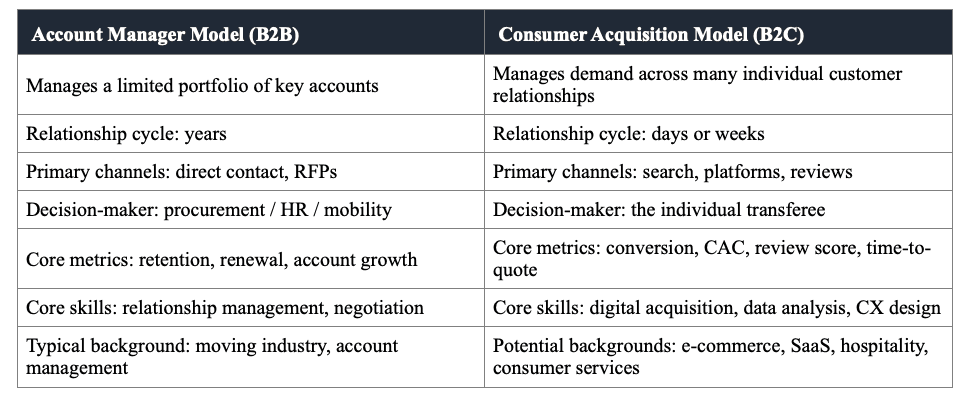
The two profiles are not interchangeable. A skilled account manager does not automatically know how to run paid search, interpret a conversion funnel, manage online reputation, or optimise a quote flow for mobile. The reverse is equally true: a digital specialist does not automatically understand customs, destination-agent coordination, or the operational complexity of a door-to-door household goods shipment.
The talent challenge is not replacing one profile with the other. It is building an organisation that can operate both.
Five Capabilities Moving Companies Need in a Consumer-Led Market
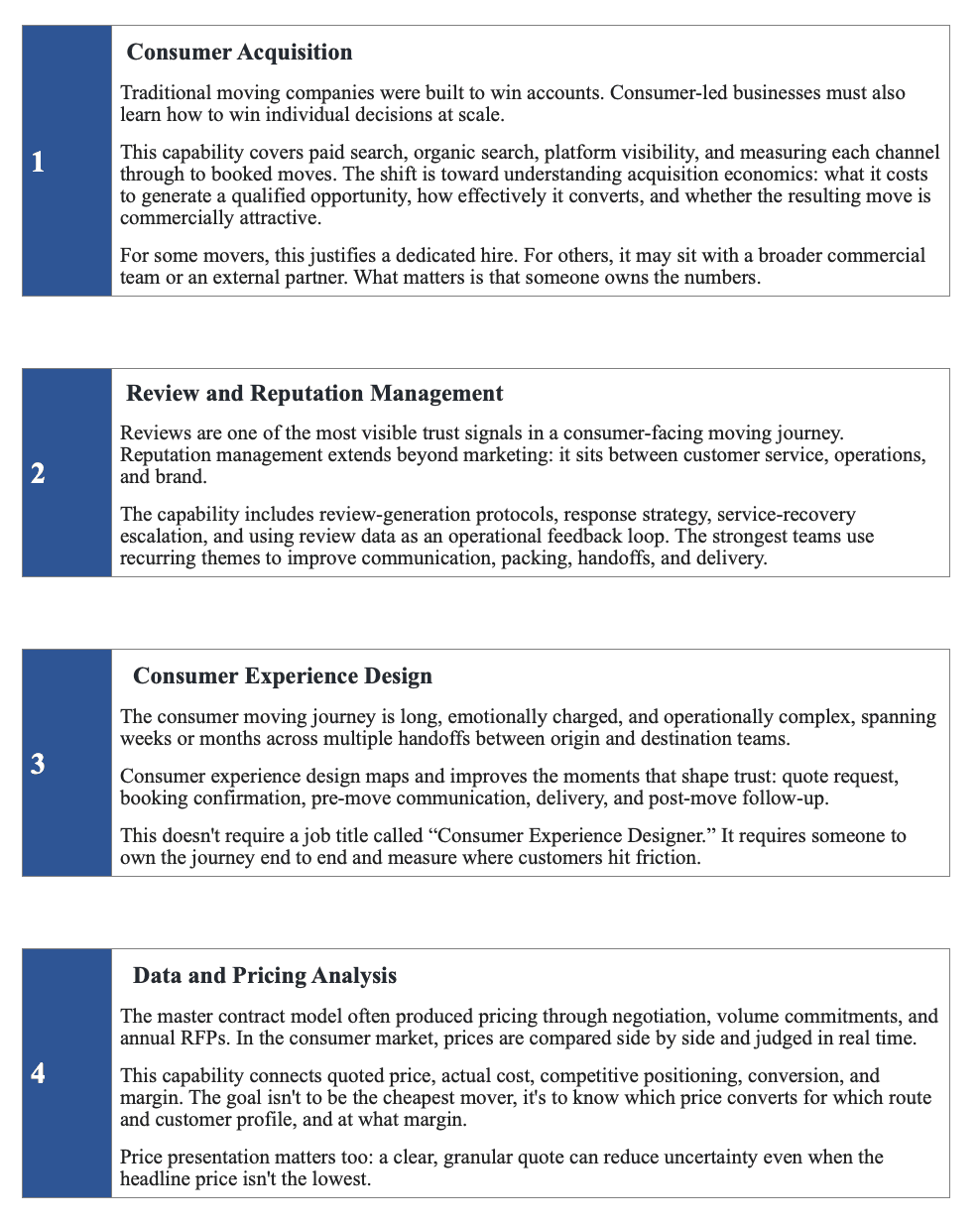
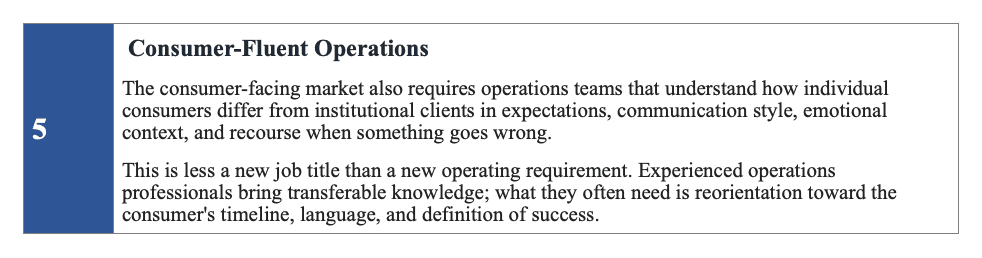
The consumer-facing moving market is not a single function. It is a set of interlocking capabilities. Some companies will build dedicated roles for each; others will combine them, retrain existing staff, or use external partners. What matters is that each capability has clear ownership.
How Moving Companies Are Closing the Gap
The strongest response is not to dismantle the B2B talent base. It is to add consumer-facing capability around it. Three moves stand out.
Hire from adjacent consumer industries
Consumer acquisition, reputation management, pricing, and customer-experience skills are mature in sectors such as e-commerce, hospitality, SaaS, and financial services. Moving companies can recruit from these adjacent industries rather than limiting searches to moving-sector candidates.
The trade-off: external hires bring consumer expertise but need to learn the operational realities of international moving, making onboarding and partnership with experienced movers essential.
Retrain the existing B2B talent base
The account-management talent that built the institutional business remains a major asset: deep industry knowledge, strong operational instincts, and credibility with destination partners.
Retraining should be specific and practical: consumer communication, review-response protocols, journey mapping, and digital-channel literacy.
The goal is not to turn an account manager into a digital marketer. It is to make an account manager consumer-fluent.
Build a hybrid organisational structure
A practical transition model maintains the B2B commercial function while establishing clear ownership for B2C acquisition and customer experience. Sharing infrastructure but using different metrics and incentives where needed.
Over time, the objective should be knowledge transfer rather than permanent separation. Thus giving consumer capability room to mature without losing the institutional expertise already inside the business.
The Roles That Are Not Going Away
It would be a mistake to read the talent gap as a verdict against B2B talent. Institutional clients will continue to matter, and the account managers who understand international logistics, destination partners, and complex corporate procurement remain difficult to replace.
What the lumpsum transition changes is that this expertise is no longer sufficient on its own. The stronger competitive position is a combined one: retain the institutional knowledge the industry has built over decades while adding the consumer capabilities the old model did not require at scale.
A Practical Framework for Closing the Gap
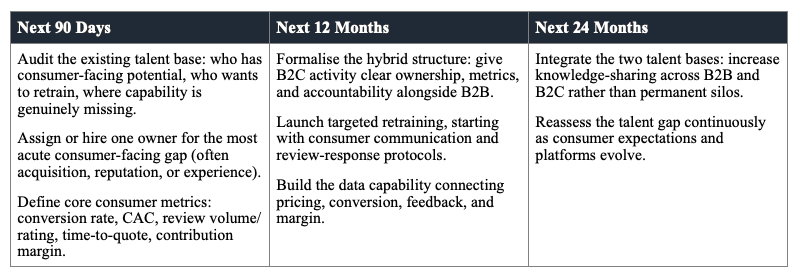
The talent gap cannot be closed overnight. A more useful approach is to sequence the work: understand the current team, establish ownership for the biggest missing capability, build the measurement layer, and then expand.
The Talent Gap
The lumpsum shift has changed the answer to a fundamental question for moving companies: who do we need to build the next version of this business?
The answer is not to replace decades of moving expertise with a team of digital specialists. Nor is it to assume that the capabilities that won corporate accounts will automatically win individual consumers.
The strongest model combines both.
Moving companies need people who understand international logistics, complex moves, and institutional relationships, as well as people who understand consumer acquisition, digital reputation, pricing data, and customer experience.
Building that combination takes time. Which is precisely why the talent question cannot wait until the consumer market is fully mature.



Vendors
More like this