Why Google Reviews, Trustpilot, and online reputation have become the most important competitive advantage for international moving companies in the lumpsum era.
Before an expat ever contacts a moving company, they have usually already made their first decision: whether they trust it.
That decision used to belong to someone else. For four decades, proof of a mover's quality meant one thing: a signed contract with a tier-one relocation management company. The RMC vetted the mover. The corporation approved the relationship. The expat never had to judge the mover's competence alone, the institutional framework had already done that work for them.
That contract was, in effect, a master credential. It told the corporate, the RMC, and the expat that the mover was trustworthy, capable, and worthy of the assignment. On that basis, movers built their reputation, not through individual customer experiences, but through institutional endorsements.
The lumpsum era has ended this arrangement. The expat is now the customer. The RMC is no longer the gatekeeper. And the old credential has been replaced by a new one, in the consumer-facing market.
That credential is the review
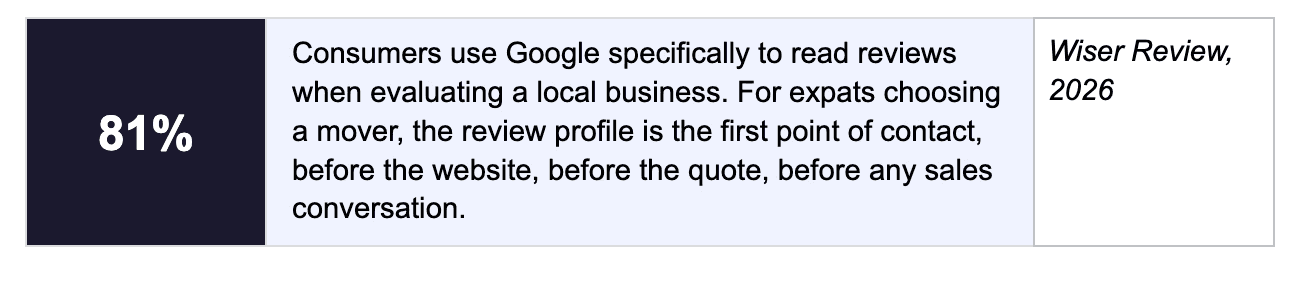
An expat planning an international move in 2026 will almost always search for a moving company's reviews before requesting a quote. They read the recent ones, the negative ones, and the responses. They compare volume and rating across the platforms that matter to them. They form a quality judgment before the moving company gets any chance to make a sales pitch.
The review is, in this sense, the new master contract. It is the credential expats use to judge quality without institutional help. And it's the asset the lumpsum era has elevated, from a marketing afterthought to a strategic priority.

Why Reviews Matter More in the Moving Market Than in Most Consumer Markets
Reviews matter in most consumer markets. They matter disproportionately more in international moving, for three structural reasons.
The customer cannot directly observe the service in advance. An international move only reveals its quality after the fact, often only once the goods are already in transit. Reviews act as a proxy for that quality. They're the only proxy the expat has before committing.
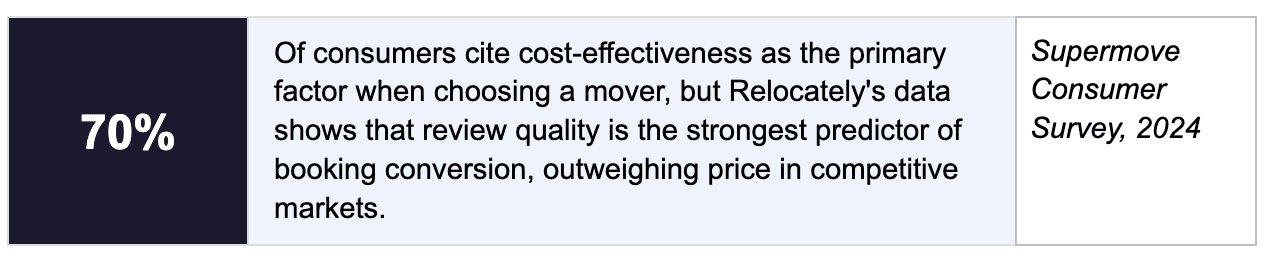
The cost of failure is high relative to the price gap between movers. A lost shipment, a customs delay, a damaged item, these are serious outcomes for the expat. The price gap between a €4,000 mover and a €5,000 mover is €1,000. The cost of failure can run several multiples of that. The expat is optimising for risk reduction, and reviews are the clearest risk signal available.
The expat decides alone, without institutional support. Under the master contract model, the expat was insulated from the choice of mover. Under the lumpsum model, they make the call themselves, usually for the first time. Their confidence depends heavily on the experiences of others.
These three conditions are exactly where reviews carry the most weight. In this sense, the moving market looks more like the market for surgeons or lawyers than the market for consumer electronics.
New to The Lumpsum Shift?
Catch up on the previous articles:
Why Are Corporates Ending Master Contracts with Movers? — The forces driving corporations away from the master contract model.
The Economics of the Lumpsum: Who Actually Benefits When the Money Changes Hands — A closer look at the winners, losers, and hidden costs of the new model.
The Mover’s Dilemma: Why the Decisions Made in the Next 18 Months Will Determine Who Survives the Lumpsum Transition — The strategic choices moving companies now face.
The Mover’s Playbook: A Practical Guide to Winning in the B2C Era — Practical actions movers can take to compete in an increasingly consumer-led market.
How to Manage Your Relocation Lumpsum: A Practical Guide for Expats — Everything expats need to know to make smarter relocation decisions and get the most out of their lumpsum.
What Separates the Reputation Builders from the Reputation Losers
Moving companies with strong review profiles share a small set of habits. Usually, the difference isn't the quality of the move itself. A company can deliver a great move and still have a weak review profile, because quality alone doesn't become a visible reputation. Someone has to convert it.
The variable that separates builders from losers is discipline: turning service quality into public reputation, at scale.
The reputation builders share four habits
They request reviews systematically, after every move. The protocol is automated. Timing is fixed, usually 48 to 72 hours after delivery, when satisfaction peaks. The task is frictionless: a templated email with a direct link. Strong review profiles rarely come from exceptional delight. They come from asking, consistently, over hundreds of moves.
They respond to negative reviews within 24 hours, specifically and with accountability. In our data, a negative review with a prompt, specific, accountable response correlates with a higher average rating over the following six months than a profile with no negative reviews at all. Reputation builders have internalised this paradox. Reputation losers still treat criticism as a threat to defend against, not a chance to show quality in public.
They track review recency, not just average rating. A profile with a 4.7 average and no reviews in three months is, in practice, weaker than a 4.4 profile with reviews from the last month. Expats read recency as evidence of current quality.
They treat review generation as a C-suite responsibility, not a marketing task. The CEO or managing director reviews the company's reputation monthly, shows up in responses to negative feedback, and owns the profile's trajectory.
The reputation losers share three structural problems
No review request protocol. Every move without a request is a missed opportunity. Multiply that by dozens per year, and the profile ends up weaker than the actual service deserves.
Defensive responses to negative reviews or none at all. A defensive reply confirms the customer's frustration in public and tells prospective customers the company can't own its mistakes. Both outcomes are worse than the original review.
Review generation lapses during busy periods. Deprioritise it at peak season, and by the end of peak the profile has aged two to three months. Repeat that pattern, and it stays permanently stale.

The Anatomy of a Review Generation System
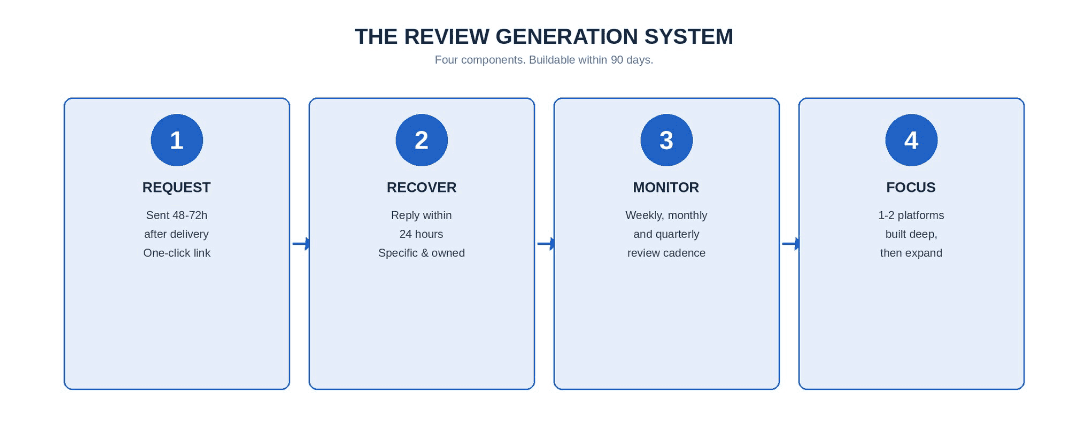
A review profile that compounds over time needs a system. It has four components. Each can be built within 90 days.
Component 1: The request protocol
Send it 48 to 72 hours after delivery, by email, with a direct link to the review platform. Automate it through the company's existing CRM, triggered by delivery confirmation.
The best request emails share three traits: personal (customer's name, destination city, coordinator's name), short (under 100 words), and frictionless (one click, no login if possible).
Component 2: The service recovery protocol
Respond to negative reviews within 24 business hours. Assign ownership to one named person. Make the response specific to the issue, acknowledge the experience, and explain the fix.
The best responses share four traits: timely, specific, accountable, and forward-looking.
Component 3: The monitoring cadence
Review the profile weekly (marketing or ops lead), monthly (CEO or MD), and quarterly for trends.
The goal: catch early signs of declining quality before they become a pattern.
Component 4: The review platform strategy
Focus first on the platforms that matter most to expats. In 2026, that's roughly: Google Business Profile, Trustpilot, and industry platforms like Relocately.
Build strength on one or two platforms before expanding. Spread thin across five, and you end up weak on all five.

The Compounding Effect
The review profile compounds more than any other digital asset in the consumer-facing moving market. Every positive review, every well-handled recovery, every month of maintained recency, each is a small deposit into an asset that becomes harder for competitors to match.
A mover with 200 reviews, a 4.6 average, and active monthly generation is, in practice, very hard to challenge in its market. A new competitor would need two to three years of consistent execution just to build a comparable history.
This is the strategic weight of the review profile in the lumpsum era. It isn't a marketing metric. It's a competitive moat, and it's still available to the movers who invest in it before the window closes.

The Question of Authenticity
One last point matters. The review profile has to be authentic. Expats in 2026 are increasingly good at spotting manufactured or solicited reviews, especially when the ask is aggressive, the reviews cluster suspiciously, or the negative-review responses read like a template.
A system built on authentic, organic, recent reviews will outperform one built on volume through incentives. The reputation builders already know this.
The strategic implication is simple: build the system around real service quality, real satisfaction, and real operational discipline. The reviews will follow. The moat will compound.
In the master contract era, movers earned business through institutional trust. In the review economy, they earn it one customer at a time.
The movers building that reputation today are building tomorrow's market share.
Continue exploring The Lumpsum Shift
Read the previous instalments: Article 1 · Article 2 · Article 3 · Article 4 · Article 5



Vendors
More like this