In the first article of this series, Why Corporates Are Ending Master Contracts, we examined why the master contract era is ending. In the second, The Economics of the Lumpsum, we traced how the lumpsum is reallocating economic value across the supply chain and who is absorbing costs that were previously invisible. The conclusion of both articles was uncomfortable but straightforward: the lumpsum is not a post-pandemic cost-control measure that will quietly unwind. It is a durable structural shift, and it is already reshaping the industry's economics at scale.
That conclusion, however, leaves the most important question unanswered.
The forces driving the transition are external to any single moving company. The macroeconomic pressure on HR budgets, the changing expectations of a digitally native workforce, the maturation of B2C comparison infrastructure, none of these are under the industry's control. What is under the industry's control is how individual companies choose to respond.
And this is where the next eighteen to twenty-four months become decisive.
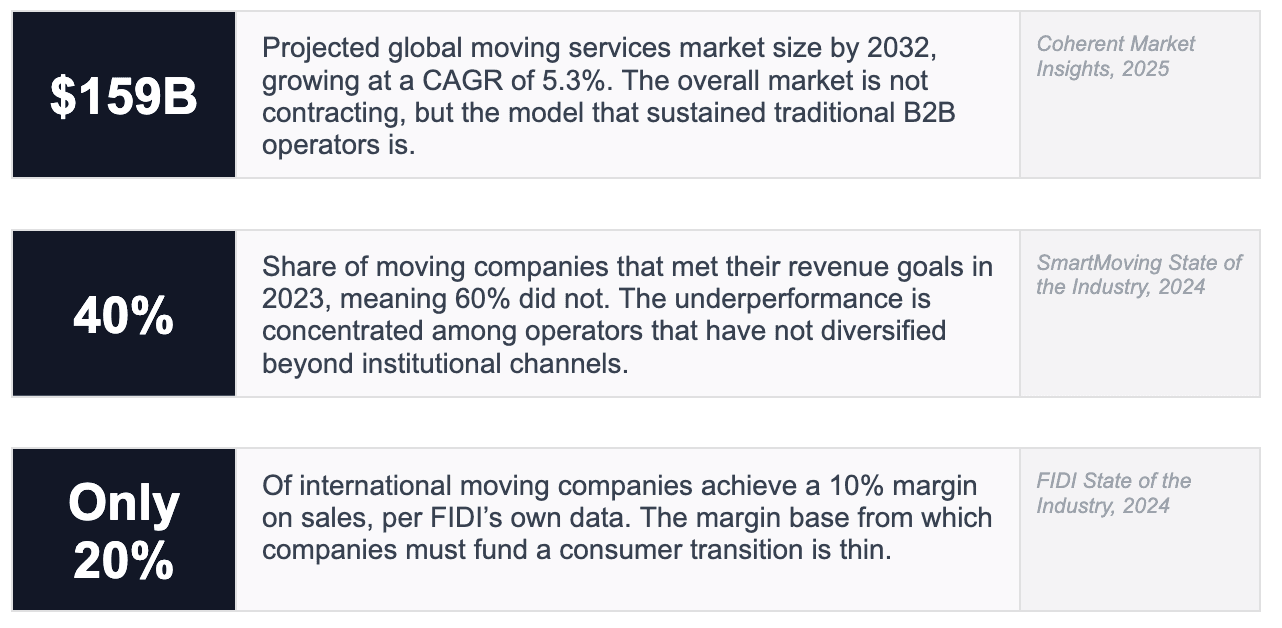
Moving companies that have invested in consumer-facing capabilities are reporting revenue growth substantially above the industry average. Those that have not are watching their traditional pipelines contract, with no visible mechanism to replace the lost volume at equivalent margin.
The performance gap between the two cohorts is already substantial. It is widening. And there is no evidence it will narrow.
A Strategic Inflection Point
Andy Grove, the former CEO of Intel, defined a strategic inflection point as the moment at which the fundamental assumptions of a business cease to hold and the company must rebuild its operating model around new ones, or begin an irreversible decline. Grove lived through one at Intel in the mid-1980s, when the company abandoned the memory chip business that had defined it and pivoted entirely to microprocessors. The decision was agonising. It was also the correct one. Intel went on to define the next three decades of computing.
The lumpsum transition is, for the traditional moving company, precisely such a moment.
Under the master contract model, a mover's competitive position rested on three pillars: relationship tenure with the RMC or corporate client; certification and compliance credentials (FIDI FAIM, ISO, IAM membership); and operational capacity fleet, warehousing, customs expertise, destination partner networks. These were genuine advantages. They accumulated over years and decades. And they were, crucially, invisible to the end consumer. The expat did not choose the mover. The RMC did. The mover's commercial success depended on being selected by a small number of institutional buyers, not by tens of thousands of individual customers.
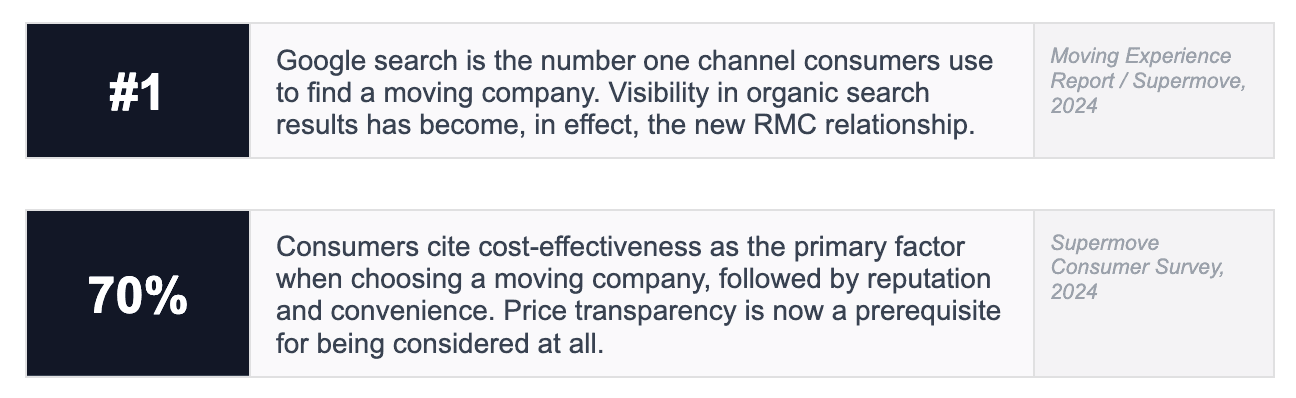
The lumpsum inverts that logic entirely. The expat is now the customer. The RMC is no longer the gatekeeper. And the mover's competitive position is no longer determined by its relationships with a handful of procurement managers it is determined by its visibility to, credibility with, and conversion of an atomised mass of individual decision-makers who have never heard of FIDI and who will make their choice based on a Google search, three quote comparisons, and a review profile.
This is a fundamentally different business. It requires fundamentally different capabilities. The companies that recognise this early are already reorganising around the new reality. The ones that treat the lumpsum as a temporary disruption are quietly entering a period of managed decline and, in many cases, have not yet recognised it as such.
What the FIDI 2024 Data Actually Shows
The whitepaper provides the first rigorous empirical picture of where the industry stands. Three findings deserve particular attention.
Finding 1: The performance gap is real, large, and widening
The survey segmented moving companies into three cohorts based on their progress in adapting to the B2C environment: leading adaptors (significant investment in consumer-facing capabilities), partial adaptors (the transition begun but B2B dependence retained), and traditional operators (business models substantially unchanged).
The performance differential is stark:
Leading adaptors report year-on-year revenue growth of approximately 22 percent, with customer acquisition costs that have stabilised following the initial investment period.
Partial adaptors report flat to modestly positive revenue growth, with acquisition costs still rising and margin under pressure.
Traditional operators report revenue contraction of 5 to 12 percent, with no visible mechanism to replace lost institutional volume at equivalent margin.
It is worth noting that these figures are self-reported and traditional operators have, historically, been more optimistic in self-assessment than subsequent operating data tends to support. The actual performance gap is likely larger than the survey figures suggest.
What is publicly documented is the structural pressure on non-adaptors:

Finding 2: The constraint is capability, not capital
A common assumption is that the barrier to consumer adaptation is financial; smaller and mid-sized moving companies cannot afford the website, the CRM, the digital marketing infrastructure required to compete for individual customers.
The FIDI data challenges this directly. Leading adaptors are not disproportionately the largest firms. Many are mid-sized operators in second-tier markets who have made targeted, disciplined investments in a small number of high-leverage capabilities: search visibility, review generation, rapid quote response, and transparent pricing. The capital required is modest. The management attention and organisational change required are not.
The binding constraint, in other words, is not financial. It is the willingness of senior leadership to treat the consumer transition as an explicit strategic priority and to reallocate management time, hiring decisions, and incentive structures accordingly. This is harder than writing a check. It is also the reason that the leading adaptors are not clustered among the best-capitalised firms.
Finding 3: The RMC channel is not dead, but it is no longer sufficient
A third finding requires careful handling, because it complicates the otherwise clean B2B-to-B2C narrative.
The lumpsum transition has not eliminated the institutional channel. RMCs continue to manage significant corporate mobility programmes, particularly at the senior executive tier and for complex, multi-jurisdiction relocations where the employee neither wants nor is equipped to manage the logistics independently. For most moving companies, a complete exit from the institutional channel is neither necessary nor advisable.
The strategic question is not whether to abandon the RMC relationship. It is whether to continue treating it as the central pillar of the business, or to manage it as one of several revenue sources, a high-margin adjacency that complements, rather than substitutes for, a growing consumer capability.
The leading adaptors have made this repositioning. They serve RMC clients, often at better margin than before, because they no longer need that client to survive. The companies that depend on the institutional channel for the majority of their revenue, growth, and strategic direction are not merely B2B businesses. They are structurally exposed.
Five Decisions That Will Determine the Outcome
For an established moving company navigating this transition, the strategic landscape can be reduced to five high-leverage decisions. Each is consequential. Each is time-sensitive. Each is interconnected with the others.
Decision 1: Channel Diversification
The foundational question: what proportion of revenue should come from institutional channels versus direct consumer channels?
There is no single correct answer. The optimal mix depends on the company's existing client base, geographic footprint, and the maturity of the consumer market in its operating regions. But the directional answer is unambiguous: the consumer channel should be growing faster than the institutional channel, and the institutional channel should be actively managed as a high-margin adjacency rather than as a growth engine.
Moving companies that continue to treat the institutional channel as their primary strategic focus are, in effect, making an implicit bet that the lumpsum transition will partially reverse. The available evidence provides no basis for that bet.
Decision 2: Digital Visibility as a Core Competency
In the master contract era, visibility to the RMC was a relationship function, maintained through account management, conference attendance, and contract renewal cycles. In the lumpsum era, visibility to the expat is a search, content, and reputation function, maintained through organic search ranking, review volume, and the speed and quality of the digital first impression.
For most established moving companies, this is the most uncomfortable transition. Investing in search optimisation, review generation, content marketing, and platform presence is not what the industry's senior leaders trained for. It is, however, what the new market rewards.
The most successful adaptors have typically closed this capability gap not by building it organically but by partnering with consumer-facing platforms that provide immediate access to the search visibility, review infrastructure, and quote-response capability that would otherwise require a multi-year internal investment. This is the strategic logic behind the growth of platforms like Relocately: they allow a mid-sized mover to be present and competitive in the consumer market from day one, without the fixed cost overhead of building the infrastructure independently.

Decision 3: Pricing Transparency and Product Structure
The traditional quote process is structurally misaligned with how individual consumers make decisions.
The expat managing a lumpsum-funded move is not running a procurement process. They are making a consumer purchase under time pressure, typically comparing three to five options simultaneously, on the basis of price visibility, review score, and response speed. Moving companies that present opaque, quote-only pricing structures are, in effect, filtering themselves out of the consideration set before the conversation has begun.
The leading adaptors have invested in transparent pricing tiers that allow a consumer to self-select a product and form a price expectation before requesting a detailed quote. This is not competing on price. The leading adaptors are not the cheapest operators in their markets. They are, however, the most legible and in a consumer market, legibility is a prerequisite for being chosen.
Decision 4: Operational Flexibility for a Higher-Volume, Lower-Average-Revenue Market
The master contract model produced moving companies optimised for large, complex, infrequent, high-revenue moves. The lumpsum model produces a market increasingly defined by smaller, more frequent, more price-sensitive individual moves. The operational implications are significant and, for traditional operators, structurally uncomfortable.
A business built around bespoke move coordination, where a single account manager oversees a complex intercontinental shipment from origin through customs to destination delivery, carries a fixed cost overhead that is difficult to sustain at the lower average revenues of a consumer transaction. A consumer-facing operation requires a fundamentally different cost structure: higher transaction volume, lower average revenue per move, and the operational and customer service capacity to handle the resulting throughput.
The leading adaptors have restructured around this reality. The traditional operators have not. This operational cost gap is one of the principal mechanisms driving the performance differential in the FIDI data.

Decision 5: Brand and Reputation as a Strategic Asset
The most difficult decision to operationalise, and the most consequential over the long term, concerns the treatment of brand and reputation.
In a B2B environment, reputation is conferred by the institutional client. A long-standing relationship with a tier-one RMC functions as a de facto reputation asset. In a B2C environment, reputation is accumulated one review at a time, in public, by individual customers who have no obligation to be charitable. A five-star review profile earned over three years of consumer volume is not easily replicated by a competitor entering the market late.
Moving companies that have made the transition successfully treat their review profile, their response to negative feedback, and their public-facing brand narrative as a matter of senior leadership concern, not as a marketing department function. Those that continue to treat reputation as a downstream consequence of operational quality are, in effect, ceding the most durable competitive asset in the consumer market to the operators who are actively building it.
The Window Is Narrow
The window in which these strategic decisions can be made from a position of relative strength is approximately eighteen to twenty-four months from the survey date.
After that window closes, the dynamic reverses. Companies that have not yet adapted will find themselves attempting the transition from a position of contracting revenue, declining operational capacity, and diminishing organisational energy. Meanwhile, the leading adaptors will have accumulated review volume, search authority, and consumer brand equity that becomes progressively more expensive to displace.
This is not, in itself, a prediction of industry consolidation, though consolidation will certainly occur. It is a prediction of competitive stratification: a widening, increasingly irreversible performance gap between the companies that adapted and the companies that chose to wait. The assets that define consumer market leadership are accumulative. Every month that a traditional operator defers the decision is a month that a leading adaptor is compounding those assets.
The gap does not close. It compounds.
The Choices That Matter
The lumpsum transition is not a crisis in the conventional sense. The industry is not collapsing. International relocation volumes continue to grow. The global market for household goods moving services is larger today than it was five years ago, and it will be larger still in five years' time.

What is contracting is the economic model that sustained a particular kind of moving company: one optimised for institutional relationships, relationship-driven sales, and bespoke operational delivery at low volume and high margin. That model served the industry well for forty years. It is no longer the model the market rewards.
The companies that recognise this and that act on it in the next eighteen months, with the discipline to make hard choices about channel mix, digital capability, pricing structure, operational scale, and brand investment, will define the competitive structure of the global moving industry for the next decade.
The companies that defer the decision, that treat the lumpsum as temporary, or that retreat further into a shrinking institutional client base, will find, when the window finally closes, that the time to adapt passed quietly, without announcement, without obvious crisis, and without the option to revisit it.
Stay in the loop



Vendors
More like this