Learn what your relocation lumpsum covers, what it doesn’t, and how to make smarter decisions when planning your international move.
If you have just received a lumpsum to manage your international relocation, this article is for you.
The previous four articles in this series examined the structural shift reshaping the global moving industry. That structural analysis matters. It is the reason the lumpsum exists, and it is the reason organising your own move feels, in 2026, the way it does.
But if you are packing up a household, coordinating a shipment across borders, and trying to make a €10,000 budget stretch, structural analysis is not what you need. At 11pm, comparing quotes from three movers and trying to work out which one you can trust, you need practical answers.
This article is the practical companion to the rest of the series. It is written for the expat, not the industry. It is designed to be read in one sitting, with a cup of coffee, before you start requesting quotes.
What Is a Lumpsum, Exactly?
A lumpsum is a fixed amount of money your employer gives you to cover the cost of your international relocation, in place of arranging and managing the move on your behalf.
The typical European lumpsum in 2024–2025 falls between €5,000 and €15,000, depending on your destination, seniority, and whether the package covers a family. The median sits in the €8,000–€10,000 range. Senior executives moving to higher-cost destinations typically receive more; early-career assignees typically receive less.

The defining feature of a lumpsum is that the money transfers to you, and so does the responsibility. Your employer is no longer coordinating the move, vetting the movers, or intervening if something goes wrong. You are.
This does not mean the model is broken. It means you need to be a more informed participant in the process than employees were a generation ago. This article is designed to help you do exactly that.
New to The Lumpsum Shift?
Catch up on the previous articles:
Why Are Corporates Ending Master Contracts with Movers? — The forces driving corporations away from the master contract model.
The Economics of the Lumpsum: Who Actually Benefits When the Money Changes Hands — A closer look at the winners, losers, and hidden costs of the new model.
The Mover’s Dilemma: Why the Decisions Made in the Next 18 Months Will Determine Who Survives the Lumpsum Transition — The strategic choices moving companies now face.
The Mover’s Playbook: A Practical Guide to Winning in the B2C Era — Practical actions movers can take to compete in an increasingly consumer-led market.
What a Lumpsum Typically Covers and What It Often Does Not
Lumpsum packages vary considerably by employer, destination, and seniority. There is no universal template. But the most common structure, drawn from FIDI's 2024 analysis of more than 240 corporate lumpsum programmes, looks approximately like this:
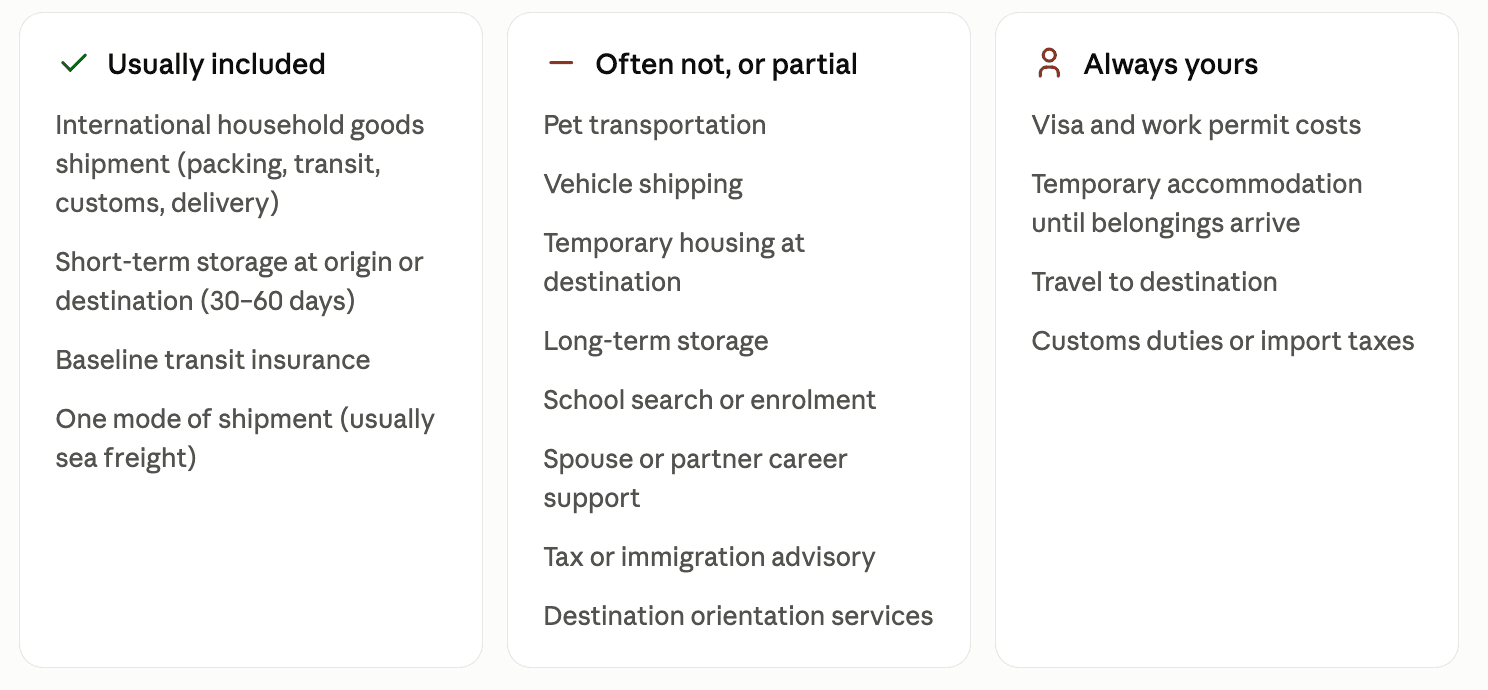
Usually included:
International household goods shipment (origin packing, transit, customs clearance, destination delivery)
Short-term storage at origin or destination (typically 30–60 days)
Transit insurance (often with a standard coverage limit, frequently with an upgrade option)
One mode of shipment (usually sea freight; air freight sometimes available at additional cost)
Often not included, or only partially covered:
Pet transportation
Vehicle shipping
Temporary housing at destination
Long-term storage
School search or enrolment support
Spouse or partner career support
Tax or immigration advisory
Destination services (orientation tours, neighbourhood guidance, utility setup)
Almost always the employee's responsibility, regardless of lumpsum:
Visa and work permit costs
Temporary accommodation until your belongings arrive
Travel to destination
Customs duties or import taxes (varies significantly by country)
Before you do anything else, request a written summary of what your lumpsum covers and what it does not. Most employers have this document; many do not volunteer it proactively. Knowing the boundaries of the package determines every subsequent decision.
The Five Most Common Mistakes
FIDI’s whitepaper, supported by Relocately’s data on thousands of consumer-initiated moves, highlights five recurring mistakes. Most are avoidable with basic preparation.
Mistake 1: Treating the lumpsum as a guaranteed budget
The lumpsum is designed to cover a typical move, but larger households, expensive destinations, or specific requirements can quickly push costs beyond the budget.
The mistake is assuming it will be enough without checking. Get quotes from at least three movers early. If the numbers do not add up, you still have time to reduce the scope, request a top-up from your employer, or plan for the difference.
Mistake 2: Choosing on price alone
The lumpsum creates a natural incentive to minimise spend. This is rational but unreliable as a decision criterion. International moving is a high-stakes, high-friction market. The cheapest quote is frequently the one with the most exclusions, the weakest transit insurance, the least reliable destination delivery, or the most aggressive estimate of cubic volume, the primary cost driver in international shipping.

Relocately's data points to a stronger predictor than price: the quality of the customer experience during the quoting process. Movers that quote slowly and opaquely before booking almost always perform worse during the move itself. The pre-booking experience is a leading indicator of the in-move experience.
Mistake 3: Underinsuring the shipment
Most lumpsum packages include baseline transit insurance, typically capped at a low per-kilogram or per-item value. For most households, this coverage is insufficient to replace the contents of a home in the event of a total loss, which, while statistically rare, does happen.

Ask each mover for the specific coverage limit of the baseline policy, and the cost of upgrading to full replacement-value coverage. For most international moves, the upgrade costs between €100 and €400. It is, in most cases, worth it. The cost of a move that loses uninsured items in transit is, in financial and emotional terms, considerably higher than the cost of the premium.
Mistake 4: Ignoring destination costs
International moving has two distinct cost components: origin services (packing, loading, export customs) and destination services (import customs clearance, delivery, unpacking). Many expats focus on the origin quote and are surprised by the destination.
Destination costs vary enormously by country. A move to Germany, the Netherlands, or the United Kingdom is relatively straightforward. A move to Brazil, India, or many sub-Saharan African destinations can involve destination costs that substantially increase the total .
Request a fully door-to-door quote, not an origin-only quote, and ask for destination costs broken out separately. If the destination cost is high, consider reducing shipment volume or accepting a longer transit time in exchange for a lower price.
Mistake 5: Booking too late
Expats who book their mover fewer than 30 days before the desired packing date routinely pay significantly more than those who book 60 to 90 days out, origin capacity is constrained at short notice, and the destination partner may not have availability on the preferred delivery date.
As soon as you have confirmed the move, request quotes from at least three movers. The earlier you book, the better the pricing, the better the scheduling, and the lower the stress in the weeks before departure.
How to Choose a Mover: A Practical Checklist
A lumpsum puts you in the position that a corporate relocation manager used to occupy. This is liberating. It is also, for someone unfamiliar with the international moving market, a little daunting.
The following checklist reflects the criteria that, in Relocately's data, most reliably predict a successful consumer-initiated move.
Verified credentials. Look for industry certifications, FIDI FAIM, IAM membership, ISO 9001 and verify that they are current. A FIDI FAIM accreditation is the most rigorous quality standard in the international moving industry. It is not a guarantee, but it is the most meaningful signal available.
Review volume and rating. In a consumer market, reviews are the most legible proxy for service quality. Look for a mover with at least 50 reviews, an average rating above 4.5, and reviews posted within the last 30 days. A mover with no recent reviews is a mover whose recent service quality is unknown.
Transparent pricing. The written quote should break out the major cost components and specify the assumed volume in cubic meters. A mover that refuses this level of detail, or provides a single total with no breakdown, is making it difficult for you to compare. That is a red flag.
Responsiveness. The quote should arrive within 48 hours of your request. Questions should be answered within 24 hours. As noted above, pre-booking responsiveness is the strongest predictor of in-move responsiveness.
Destination capability. Verify that the mover either has its own destination operations in your target country or works with a named, vetted destination partner, ideally one that is FIDI- or IAM-affiliated. The most useful question you can ask: "How many moves have you completed to [destination city] in the last 12 months?"
Insurance and liability terms. Read them before booking, not after. The coverage limit, the deductible, the exclusions, the claims process, these are not negotiable once the shipment is in transit.
A Note on Clawback
The lumpsum is calibrated to cover a typical move. But not every move fits that profile. Your household may be unusually large. Your destination may have high customs or delivery costs. Or you may have specific requirements that push the total cost beyond the available budget.
The mistake is assuming the lumpsum will be sufficient without checking. The gap often becomes clear only halfway through the process. Request quotes from at least three movers before committing. Ask each mover whether your household size and destination are realistic for your budget. If they are not, you will know early. You can then reduce the scope, request a top-up from your employer, or plan around the difference.
What to Do When the Numbers Don't Add Up
Occasionally, the lumpsum is genuinely insufficient. This is most common for moves to high-cost destinations, for households with unusual requirements, or when the corporate mobility policy has not kept pace with current market pricing.
The options, in rough order of preference:
Request a top-up from your employer. This is more common than most employees realise, and most HR departments have a process for it. Frame the conversation around the specific quotes you have received and the specific gap. The conversation is considerably easier when you come with data.
Reduce the shipment volume. This is the most powerful cost lever available to you. A meaningful reduction in cubic meters typically produces a proportional reduction in total cost. Most expats ship more than they need to. Be ruthless.
Accept a longer transit time. Sea freight pricing varies with transit time. A longer transit is materially cheaper. If your timeline allows it, this is one of the most reliable cost reductions available.
Self-manage the destination leg. If you are comfortable handling unpacking and placement at destination yourself, you can often reduce destination service costs significantly. This is not for everyone, but for expats with manageable shipment volumes it is a genuine saving.
Cover the gap personally. If none of the above closes the shortfall and the move is non-negotiable, covering the difference yourself is occasionally the right answer. It is, in our experience, the least common outcome.
A Final Word
Managing a lumpsum-funded move is not simple. It is a major part of an expatriate year. The decisions matter. The stakes are real. And most expats receive less support than under the corporate-managed model.
That does not make the model broken. It makes the move yours.
A lumpsum gives you more choice. You can choose your own mover. Set your own priorities. And organise the move around your household and needs.
But without the right approach, it can add unnecessary stress to an already major life transition.
So far, The Lumpsum Shift has mainly been written for the industry that serves you. This article is different. It was written for you.
Ready to put it into practice? At Relocately, you can compare verified movers, read genuine reviews, and request transparent quotes from companies that meet the standards outlined above.
Continue exploring The Lumpsum Shift
Read the previous instalments: Article 1 · Article 2 · Article 3 · Article 4



Start now
More like this