For decades, the global moving industry ran on a simple, predictable engine: the master contract. Shell signs a five-year agreement with a single moving company. Unilever does the same. IBM, HSBC, Procter & Gamble, the names changed, but the model held. A multinational would forecast its annual relocation volume, segment it by region, and hand the whole operation to a trusted logistics partner. The mover got predictable volume. The corporation got predictable pricing. The relocation management company (RMC) in the middle collected its margin. Everyone had a role. Everyone, more or less, won.
That model is disappearing, faster than most people in the industry are willing to admit.
In the last five years, quietly and without much fanfare, some of the world’s largest employers have begun unbundling their relocation programmes. Instead of signing massive multi-year contracts, they now hand each relocating employee a lump sum and say, in effect: figure it out.
It is one of the most consequential structural shifts in the history of corporate mobility. And almost no one outside the industry is paying attention.
This is The Lumpsum Shift, a six-article series examining how this transition is reshaping the moving industry, what it means for the companies that serve it, and where the entire ecosystem is heading next.
The Scale of the Shift: What the Data Shows
Before examining the forces driving this change, it is worth establishing its magnitude. The numbers have become hard to ignore.
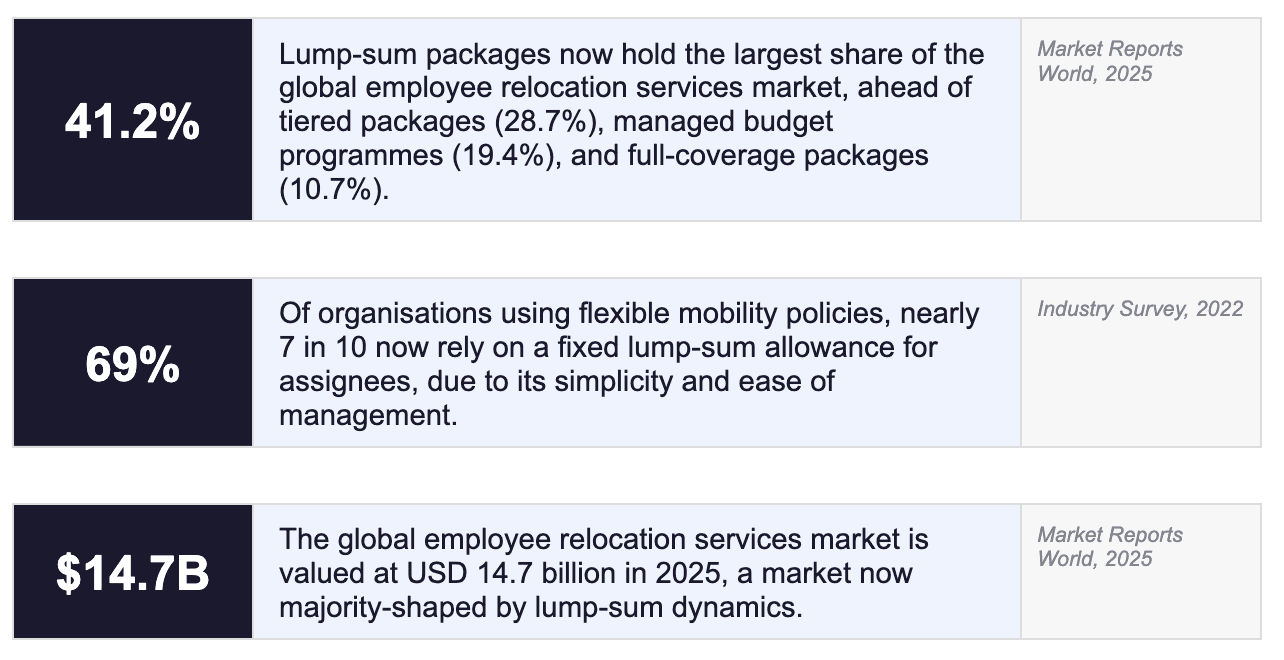
Shell, Unilever, and multiple major financial institutions have publicly discussed their transitions toward lump-sum-dominated mobility programmes at industry conferences. The trend is not confined to any single sector, geography, or employee tier. FIDI Global Alliance dedicated a full 2024/25 whitepaper to the question: “Are lump sums still a good solution for international relocations?”, a sign that even the industry’s leading quality body is grappling with the shift.
The Master Contract Era: How We Got Here
To understand where the industry is going, you have to understand what it was built on.
For most of the post-war era, corporate relocation was a closed, relationship-driven business. A multinational would retain a relocation management company to manage the logistics of moving talent across borders. Those RMCs, in turn, would sign master service agreements with a handful of tier-one moving companies in each region. It was a system built on trust, volume, and incumbency.
The economics were elegant, at least on paper:
For the corporate: one contract, one point of contact, one predictable annual spend. HR teams didn’t need to become experts in international freight, customs regimes, or household goods insurance. They delegated, and the machine ran.
For the mover: a guaranteed pipeline of high-value moves. No marketing spend, no prolonged sales cycles, no customer acquisition costs. Just contracted, consistent work with blue-chip clients.
For the RMC: a durable margin for aggregating demand and managing vendors, a model that scaled beautifully as multinational footprints expanded through the 1990s and 2000s.
This model functioned brilliantly for four decades. It made global talent mobility possible at a scale that would have been unimaginable to earlier generations. A mid-career manager could be reassigned from London to São Paulo without the HR team needing to understand what any of it involved.
But the model carried a structural weakness that compounding cost pressures and a changing workforce would eventually expose. It was built for a world that no longer exists.
Five Forces Driving the Change
The shift from master contracts to lump-sum packages was not triggered by a single corporate decision or a single market event. It was the result of five forces converging simultaneously, each accelerating the others.
1. Intensifying Pressure on Programme Costs
In the post-2010 era, HR and mobility budgets came under serious scrutiny. CFOs began demanding full visibility into the total cost of relocation and the picture that emerged was rarely flattering.
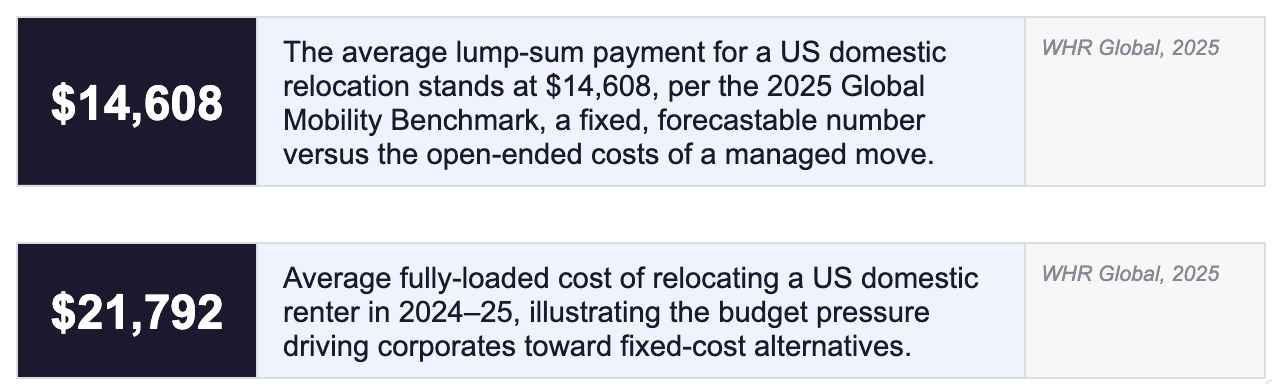
Master contracts, for all their elegance, were expensive to operate. RMC fees layered on top of mover fees. Internal mobility specialists. Management overhead. Duty-of-care obligations that extended across months. When finance teams ran the full analysis, they frequently found that the fully-loaded cost of relocating a single employee was 30 to 50 percent higher than the mover’s invoice suggested.
Lump-sum packages offered a structurally different alternative: a fixed, pre-determined cost per employee that HR could budget to the cent. No layered margins. No administrative overhead. No invoice disputes after the fact.
2. The Rise of the Empowered, Digitally Native Employee
The second force is generational, and it is easy to underestimate.
Today’s relocating employees are not the trailing spouses and expatriate lifers of the 1980s. They are digital natives who independently book international travel, source accommodation on Airbnb, manage their own investment portfolios, and comparison-shop for almost everything. When this cohort receives a lump sum and is told to organise their own move, they don’t feel abandoned. They feel trusted.
This was not true two decades ago. The employees of 2005 needed institutional hand-holding because the information infrastructure to support independent decisions simply did not exist. The employees of 2025 don’t, because it does. The psychological framing has inverted: a managed relocation now feels paternalistic to many; a lump sum feels like autonomy.
3. The Structural Fragmentation of Global Talent Mobility
The third force is structural, and perhaps the least discussed.
In the 1990s, roughly 95 percent of international moves were intra-company transfers, a manager moving from the London office to the Singapore office, within a known employment relationship, within a defined duty-of-care framework. Today, that figure has fallen substantially. The remainder consists of new external hires crossing borders, independent contractors, and hybrid remote workers establishing residency in new jurisdictions.
Master contracts were designed specifically for the intra-company transfer. They assumed a pre-existing employment relationship, organisational visibility into the employee’s compensation package, and a clearly defined duty-of-care obligation. The new mobility landscape does not map onto that assumption. Lump-sum packages are, at least in part, a pragmatic response to a workforce the old model was never designed to serve.

4. The COVID-19 Acceleration
The pandemic did not originate from the lump-sum trend. But it compressed a transition that might otherwise have taken a decade into the span of two years.
In 2020 and 2021, corporate mobility volumes collapsed almost overnight. Multinationals cancelled contracts, renegotiated agreements, and drastically reduced their internal mobility headcount. Many used the window of crisis to pivot to a more flexible, lower-commitment model. Lump-sum packages allowed mobility programmes to continue operating, at reduced cost, without the fixed obligations of a master contract.
What began as a temporary cost-containment measure has, for a significant number of organisations, become the permanent baseline. Once mobility teams demonstrated that lump-sum programmes could operate at scale without catastrophic service failures, the case for returning to the old model weakened considerably.
5. The Maturation of B2C Relocation Infrastructure
The fifth force is the one most consistently underappreciated; including, notably, by the industry itself.
Lump-sum packages only work in practice if employees have access to credible, convenient alternatives to corporate-provided services. For most of the industry’s history, those alternatives did not exist at any meaningful scale. An expat moving to Amsterdam could use the mover their employer nominated, or they could spend weeks piecing together quotes, references, and logistics arrangements with no reliable mechanism to verify service quality.
That constraint has been lifted. Platforms like Relocately now allow employees to compare verified, reviewed movers; request and compare quotes; and complete the booking process entirely online, often within hours. The infrastructure for a functioning B2C relocation market exists today in a way it simply did not ten years ago. The technology did not merely accompany the lump-sum shift; it enabled it.
What This Means For Everyone
The consequences of this shift are asymmetric, and they are already playing out.
For moving companies: the guaranteed pipeline of the master contract era is contracting. The new revenue pool is consumer-facing, review-dependent, and won on service quality rather than relationship tenure. With 54% of companies reporting increased relocation volumes in 2025 (Atlas Van Lines), the addressable market is not shrinking, but the route to it has fundamentally changed.
For RMCs: the margin model that sustained the industry for 40 years is under direct structural pressure. The firms that survive will be those that find new value to deliver rather than logistics intermediation.
For relocating employees: for the first time, they are the customer. They hold the budget. They choose the provider. They leave the review. The balance of power in the transaction has shifted decisively in their direction.
And for platforms built to serve this new reality: the moment they were designed for has arrived.
Stay in the loop



Verkopers
Meer van dit