

Every moving company navigating the lumpsum transition will face the same question within the next eighteen months. How do we build the consumer-facing capability we need to compete? There are only three possible answers. The choice between them will shape the competitive structure of the global moving industry for the next decade.
The Three Options, Defined
Build means constructing consumer-facing infrastructure internally. Search visibility, quote response, online booking, review aggregation, all built in-house.
Buy means acquiring an existing technology solution. It's then integrated into current operations.
Partner means entering a commercial relationship with an established consumer-facing platform, such as Relocately. The moving company accesses the infrastructure on a per-transaction or subscription basis. It doesn't build or own the underlying technology.
These options aren't strictly mutually exclusive. A company that partners may still build content and brand internally. But the choice of primary route to the consumer-facing market dominates the decision. The organizational implications of each path differ sharply.
What the Build Option Actually Requires
Build is, in principle, the most attractive option. Full control of the consumer experience. Full ownership of the customer relationship and its data. Full strategic flexibility. It's also the option most moving companies have attempted, and the one with the most consistent record of underperformance.
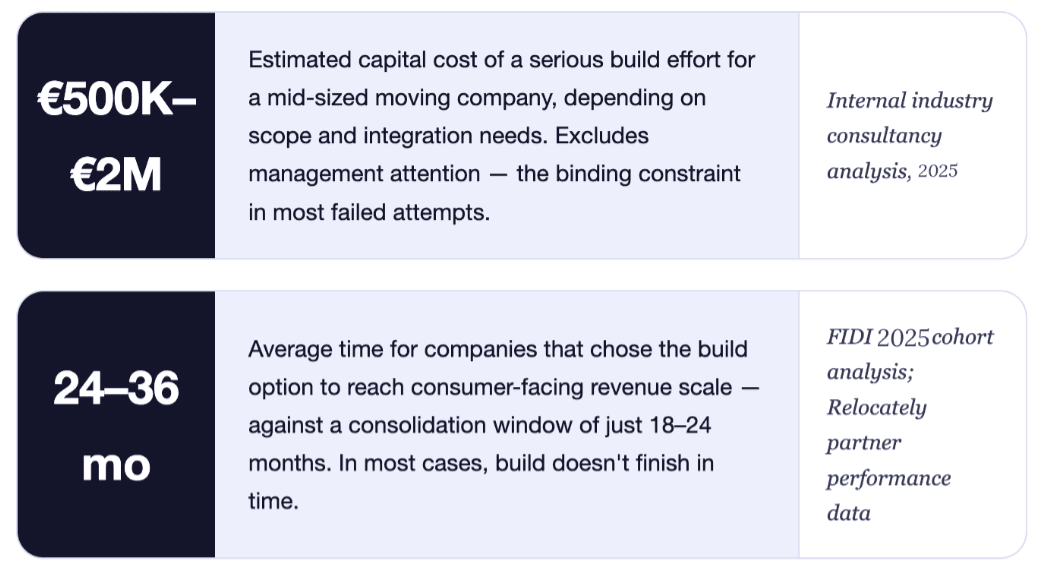
The infrastructure required is more complex than most leaders initially estimate. Four components consistently exceed projections:
Search infrastructure. Ranking organically for the high-intent search categories expats use isn't a single project. It's an ongoing program requiring technical SEO expertise, content production, link-building, and continuous monitoring.
Review infrastructure. Generating, aggregating, and responding to reviews across the platforms expats use requires embedded operational discipline, not a software install.
Consumer-facing UX. The most visible component, and the one companies most consistently overinvest in. A polished website without search visibility is a billboard in a desert. Without reviews, it's a billboard nobody trusts.
Operational integration. Connecting the front end to existing CRM, dispatch, and destination-partner systems is the most underestimated cost. Companies in our sample underestimated this work by a factor of three to five.
What the Buy Option Actually Produces
The buy option has a mixed record. This isn't because available solutions are poor. It's because moving-industry software has historically been built for the B2B relationship, not the consumer-facing one.
Enterprise CRM systems, move-management platforms, customs documentation tools, and destination-service coordination software are sophisticated, operationally robust products, refined over decades to serve institutional clients. In most cases, they're poorly suited to what the consumer-facing lumpsum market demands.
Bridging that gap requires customization work that, in our experience, rivals the build option in cost and management attention.Typically produces a result inferior to a purpose-built consumer-facing platform.
What the Partner Option Actually Provides
The partner option has produced the most consistent record of strong results among companies navigating the lumpsum transition. The leading adaptors in the FIDI 2025 cohort are, with remarkable consistency, platform partners rather than internal builders.
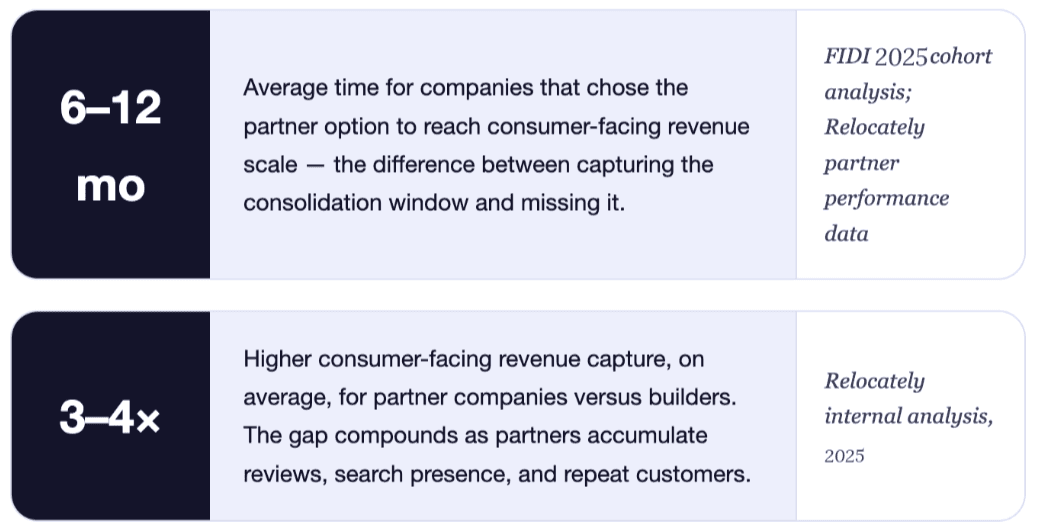
The logic is structural. A platform partner typically charges per transaction or per lead, so cost scales with commercial outcome. The company isn't committing capital to infrastructure that may or may not pay off. It's paying for access to infrastructure that already produces returns, with the platform bearing the capital cost and operational risk.
The strategic logic follows from core competency. A moving company's expertise is operational: physical relocation across borders, destination-partner management, complex international logistics. Consumer-facing infrastructure is a different discipline entirely. Partnering also provides something building cannot replicate: aggregated consumer behavior data across many moving companies and expat customers.
The Three Mistakes That Define Failed Build Attempts
Build can work, for the largest companies, with sufficient capital, management attention, and operational scale. Mid-sized companies, however, fail for recognizable reasons:
1. Underestimating the management attention required. Build is fundamentally a technology and product-development project. It needs a dedicated product manager, technical lead, design lead, and content lead working in coordination. Handing it to the existing IT, marketing, or operations team won't produce what the market requires.
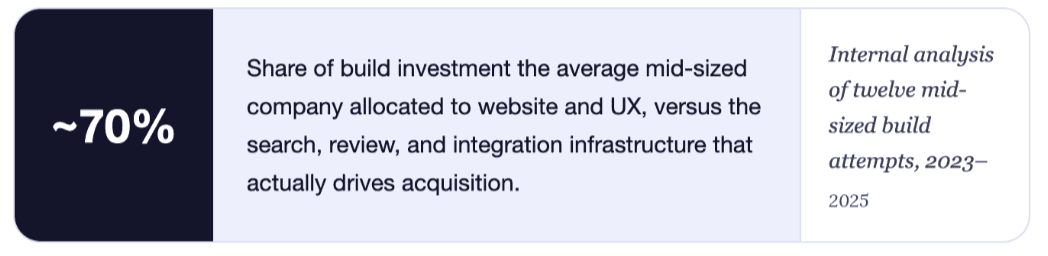
2. Overinvesting in the visible, underinvesting in the operational. That imbalance produces a polished front end that's invisible to the expat customer, because nothing is driving traffic to it.
3. Treating the build as a project with an end. The consumer-facing market never stops evolving. Treat build as a one-time project, and within 12–18 months the capability is no longer fit for purpose. Leading adaptors treat it as an ongoing program with continuously allocated resources.
What the Leading Adaptors Are Actually Doing
The FIDI 2025 whitepaper identified a cohort of companies most successfully navigating the lumpsum transition. Nearly all chose partnering as their primary route to the consumer-facing market. In parallel, they invested internally in what partnering doesn't provide: content production, review generation, customer service training, brand building.
Crucially, these companies treat the platform partnership as strategic, not transactional. They understand the platform's roadmap, contribute to product development where possible, and align internal operations with the platform's requirements.
A Decision Framework
There's no universally correct answer. The optimal choice depends on size, capital position, management bandwidth, and strategic horizon.
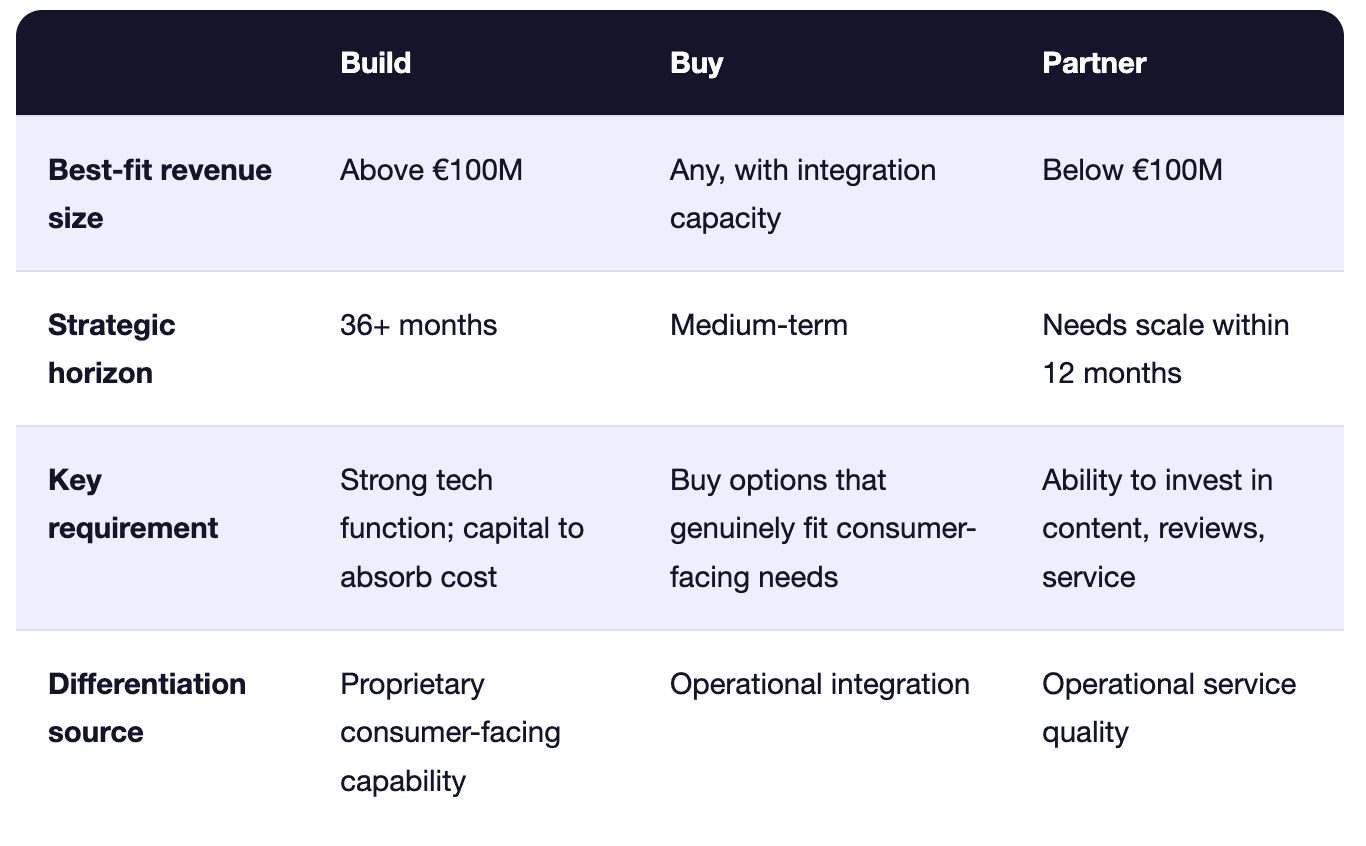
The build option is most likely to be the right choice for:
Moving companies with annual revenue above €100 million, sufficient to absorb the capital and management cost
Moving companies with a strong existing technology function that can be expanded
Moving companies whose strategic differentiation depends on consumer-facing capability that no platform partner can provide
Moving companies with a 36-month+ strategic horizon that can absorb the longer build timeline
The buy option is most likely to be the right choice for:
Moving companies whose primary need is operational integration rather than consumer-facing differentiation
Moving companies in markets where available buy options are well-suited to consumer-facing requirements
Moving companies that have the integration capacity to customise a B2B-oriented product for consumer-facing use
The partner option is most likely to be the right choice for:
Moving companies with annual revenue below €100 million, where the capital and management cost of a build is prohibitive
Moving companies that need to reach consumer-facing revenue scale within 12 months
Moving companies whose strategic differentiation depends on operational service quality rather than consumer-facing technology
Moving companies that can invest in the operational components of consumer-facing capability (content, reviews, customer service) while accessing the infrastructure through a platform
The Window, Again
At bottom, this is a timing decision. The consumer-facing moving market is consolidating over a window of roughly 18 to 24 months. Companies that choose the wrong path risk entering the market only after the leading positions are already claimed.
The lumpsum transition is the most significant structural shift the global moving industry has faced in forty years. Within it, the build-vs-buy-vs-partner decision is the most consequential strategic choice. In the current state of the market, the one that most clearly separates the companies that will lead the next phase from those that will be bypassed by it.



Verkopers
Meer van dit