The industry fears that publishing prices commoditises the service. The evidence suggests the opposite.
Moving companies have spent decades selling through relationships. Price came later, after credentials, capabilities and service quality had been established.
But the buyer has changed.
As we have explored throughout The Lumpsum Shift, more relocation decisions are moving from corporate mobility teams to employees managing their own fixed budgets. That changes not only who chooses the mover, but how that mover is discovered, compared and selected.
And few parts of the traditional moving model are more exposed to that change than pricing.
In our analysis, movers that make pricing visible tend to convert more prospects, attract higher-value customers and achieve higher average transaction values than operators that withhold any pricing signal until a sales conversation.
That sounds counter-intuitive.
If customers can see your prices, won't they simply compare you with competitors and choose the cheapest?
The evidence suggests something more interesting is happening.
This is the price transparency paradox: the movers that show their prices can win more business without competing on being the cheapest.
Understanding why this is true is the subject of this article.
New to The Lumpsum Shift?
This is part eight of our series on how the shift from master contracts to employee-controlled relocation budgets is reshaping the moving industry.
Catch up on the previous articles:
Why Are Corporates Ending Master Contracts with Movers? — The forces driving corporations away from the master contract model.
The Economics of the Lumpsum: Who Actually Benefits When the Money Changes Hands — A closer look at the winners, losers, and hidden costs of the new model.
The Mover’s Dilemma: Why the Decisions Made in the Next 18 Months Will Determine Who Survives the Lumpsum Transition — The strategic choices moving companies now face.
The Mover’s Playbook: A Practical Guide to Winning in the B2C Era — Practical actions movers can take to compete in an increasingly consumer-led market.
How to Manage Your Relocation Lumpsum: A Practical Guide for Expats — Everything expats need to know to make smarter relocation decisions and get the most out of their lumpsum.
Build, Buy, or Partner? The Strategic Decision That Will Define the Next Decade of Moving — How movers should choose between building, buying, or partnering for the consumer-facing capabilities they need to compete.
The Review Economy: How Online Reviews Became the New Master Contract for Movers — Why online reviews have become the new trust signal for movers competing in the consumer-led market.
Why the Old Logic Made Sense and Why It No Longer Does
The instinct to withhold pricing was not irrational in the master contract era. In a B2B environment, price was one input in a complex procurement decision made by professional buyers over weeks or months. The RMC evaluating a potential mover partner was assessing certification credentials, global network coverage, claims handling history, and operational capacity. Price mattered, but it was not the primary decision criterion, and the relationship was the primary competitive differentiator.
In that context, publishing a price before a relationship was established made limited commercial sense. The number, stripped of context, might anchor the buyer's expectations in unhelpful ways. Better to earn the conversation first, establish the value, and present the price once the relationship has already done some of its work.
The lumpsum transition has dismantled this logic at its foundation.
The expat managing a lumpsum-funded move is not a professional procurement manager. They compare three to five options in a single browser session. They do not pick up the phone. They do not build a relationship before forming a price expectation. They form a price expectation before deciding whether to initiate a relationship at all.
In this environment, the mover that withholds pricing information does not control the narrative. They remove themselves from the consideration set. The expat moves on to the next option, which is one click away.
The Mechanism: Why Transparency Converts
The conversion advantage of price-transparent movers is unlikely to be a coincidence. It follows directly from how the lumpsum-funded consumer makes decisions.
1. Transparency changes the decision the consumer is making
A mover that withholds pricing until the quote stage presents the consumer with a binary decision: request a quote, or move on. Many consumers will move on, not because the mover is too expensive, but because the effort required to find out whether it is is higher than the effort required to consider a competitor.
A mover that publishes starting prices changes the decision.
Instead of asking:
"Should I request a quote?"
the consumer can start asking:
"Which option fits me?"
That is a meaningfully different question.
The starting price does not close the sale. It gives the consumer enough information to continue evaluating the company and potentially enter the sales conversation with a higher level of readiness.
2. Transparency functions as a quality signal
In a market defined by information asymmetry the willingness to publish prices functions as a credibility signal. A moving company confident enough in its service quality to show what it costs is, in the consumer's inference, a company that does not need to hide behind the sales process.
Conversely, a mover that requires a phone call before revealing any pricing is, in the consumer's inference, a mover that is either uncertain of its own value or unwilling to be compared directly. Neither inference is helpful in a competitive consumer market.
This is the mechanism behind the counter-intuitive finding that transparent movers achieve higher average transaction values: they attract customers who have already decided, on the basis of the published price range, that the cost is acceptable. These customers are less price-sensitive, more ready to buy, and more likely to select premium tiers or add-on services once the conversation has begun.
3. Transparency reduces the sales cycle
With quote-only pricing, sales teams spend time on prospects who later discover the service is outside their budget, something they could have known upfront.
Transparent pricing performs part of that qualification automatically.
The consumer who requests a quote after seeing a realistic price range has already confirmed, at least approximately, that the service fits their budget.
The conversation that follows can therefore spend less time answering "Can I afford this?" and more time answering "Why should I choose you?"

The Fear That Is Costing the Industry Money
If the evidence for price transparency is this consistent, why does the industry resist it so persistently?
The answer is usually psychological rather than strategic. It reflects a well-documented cognitive bias: loss aversion.
Companies fear losing customers who see the price and walk away. That potential loss feels more immediate than the potential gain from greater transparency and higher conversion rates.
The result is a systematic misjudgement. The moving company that withholds prices is not protecting its commercial position. It is sacrificing a consistent, measurable conversion advantage in order to avoid a loss that is, in aggregate, smaller than the gain it is forgoing.
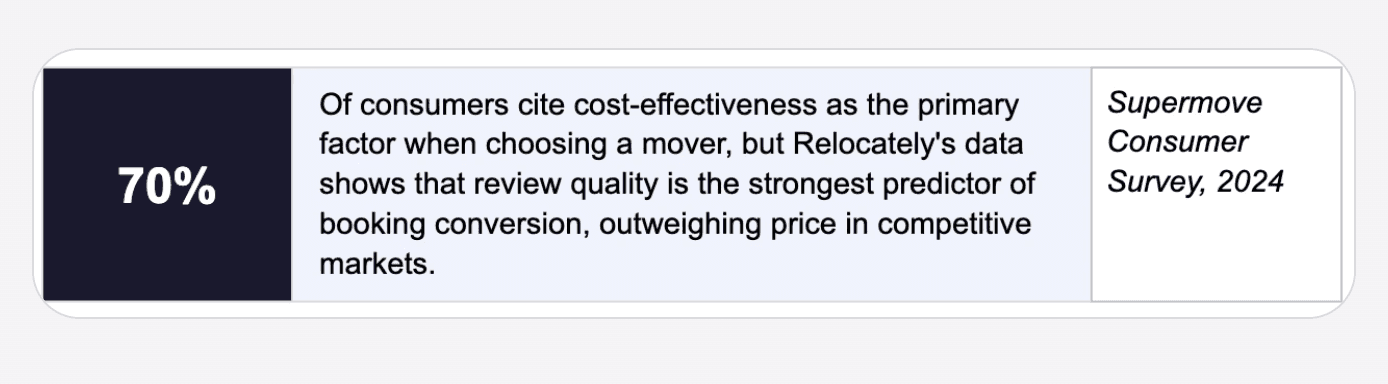
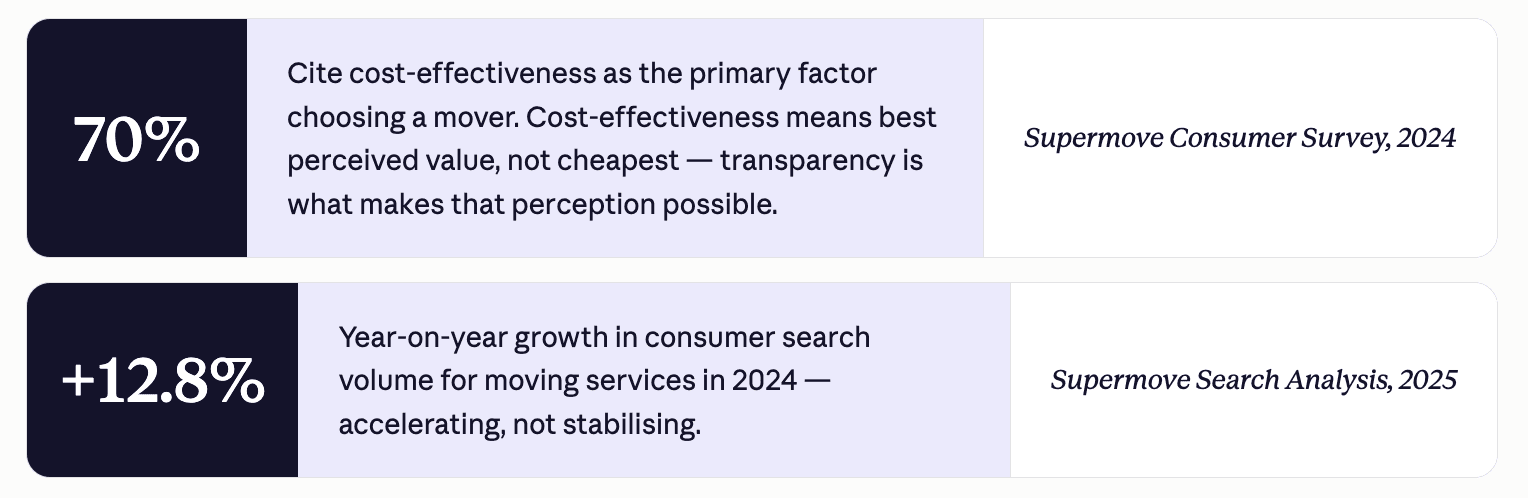
There is a second, subtler fear: the fear of being undercut. If we publish our prices, the reasoning goes, our competitors will price just below us and we will lose on cost. This fear is also largely unfounded. The consumers who use published pricing to compare moving companies are not, primarily, selecting the cheapest option. They are selecting the option that offers the best perceived value and perceived value is a function of price transparency, review quality, responsiveness, and credential visibility, not of price alone.
The mover that wins on transparent pricing is not the mover with the lowest price. It is the mover with the clearest value proposition at a price the consumer can evaluate without friction.

What Price Transparency Actually Looks Like in Practice
Price transparency does not mean publishing a complete price list. It means giving the consumer enough information to form a price expectation and self-select a tier before initiating contact. The most effective implementations in our analysis share a common structure.
Three tiers, not one quote
The leading adaptors have converged, with remarkable consistency, on a three-tier structure published on their website: an Essential tier (origin or destination services only, for the expat who has arranged the other half independently); a Standard tier (full door-to-door with standard transit times and baseline insurance); and a Full-Service tier (premium transit, enhanced insurance, packing and unpacking, short-term storage).
Each tier is presented with a starting price range, not an exact quote, but a range that allows the consumer to orient themselves. The range is honest: it reflects the actual distribution of prices for that tier in the mover's operating markets, not an artificially low anchor designed to attract clicks.
Starting prices, not exact quotes
The function of a starting price is to shift the consumer's decision, not to close the sale. A starting price of "from €3,500" for a Standard tier European move does not commit the mover to that price, it communicates that the service is in a range the consumer can evaluate. The detailed quote, requested after the consumer has self-selected a tier, is where the exact pricing is established.
Moving companies that resist this approach often cite the variability of international moving costs as the reason that a starting price is misleading. This objection is legitimate in its specifics but wrong in its conclusion. Consumers understand that a starting price is a starting price. What they do not understand, and will not wait to find out, is why a moving company cannot provide any price signal at all.
Pricing that is easy to find
The location of the pricing information on the website matters as much as the information itself. The leading adaptors present their pricing tiers on the homepage, on a dedicated pricing page, and within the quote request flow. A consumer who has to navigate more than two clicks to find a price is a consumer who may not navigate at all.

Three Moves You Can Make This Week
This is where the article earns its keep. None of the following requires a re-platform:
Test your own site. Open it in an incognito window and try to find a price for a standard European relocation in under 60 seconds. If you can't, your prospects can't either. Write down what you find.
Draft three tiers. Define honest starting-price ranges for your three most common routes. You don't have to publish them yet, defining them is the prerequisite for publishing them.
Name an owner and a date. One person, one deadline, for getting the tiers live on the website. That's the entire 30-day plan.
The Compounding Advantage
Transparent pricing isn't just a conversion tactic, over time it behaves like a moat. Movers who adopt it tend to see stronger review profiles, a brand association with honesty and confidence in a market where trust is the main purchase criterion. None of these advantages is individually dramatic. Together, over eighteen months, they add up to a meaningfully different competitive position and the gap tends to widen rather than close.
The question is no longer whether customers want a price signal. It is whether your company will provide one before a competitor does.
Continue exploring The Lumpsum Shift
Read the previous instalments: Article 1 · Article 2 · Article 3 · Article 4 · Article 5 · Article 6 · Article 7



Fournisseurs
Plus de ce genre