In the first article of this series, we examined why some of the world's largest employers are dismantling the master contract model that defined corporate mobility for four decades. In its place: a lumpsum handed to the employee, a corporate off the operational hook, and a moving industry that has either lost its most reliable customer or gained its largest addressable market, depending on who you ask.
The standard narrative is seductively clean. Lumpsum programmes save money for the corporation. They give freedom to the employee. They create opportunities for tech-savvy movers willing to compete in a B2C market. Everyone, in theory, gets a better deal.
The reality is more complicated and more interesting.
When money changes hands, it does not disappear. It moves. And wherever it moves, it creates new winners, new losers, and new frictions that remain invisible until the model is operating at scale. Two years into widespread lumpsum adoption, the data is finally granular enough to map who has gained, who has lost, and where the structural cracks are beginning to show.
This article examines the economics of the lumpsum model as it is actually functioning in 2024–2025, not as it was pitched in the post-pandemic cost-reduction memos that first introduced it.

The Corporate: A Real Saving, Carrying a Hidden Risk
The financial case for lumpsum programmes, from the employer's perspective, is unusually straightforward.
Under the master contract model, a typical intra-European relocation of a senior manager cost the employer between €12,000 and €18,000 all-in, a figure that encompassed the mover's invoice, the RMC's management fee, internal mobility staff time, and the administrative overhead of coordinating multiple vendors across multiple jurisdictions. The lumpsum equivalent for the same employee profile runs to €8,000–€10,000, with no further financial exposure for the employer once the payment is made.
That is an immediate, visible, defensible saving of 30 to 40 percent on the per-relocation cost line. For a multinational running 500 relocations a year, the arithmetic is unambiguous: lumpsum programmes are not a marginal optimisation. They are a structural rebalancing of one of the largest discretionary cost lines in the HR budget.

The saving, however, is partially offset by a risk that has only recently begun to register in corporate compliance and legal functions: duty of care does not transfer with the lumpsum.
A UK Employment Appeal Tribunal ruling in late 2023 reinforced a principle that many mobility teams had quietly preferred not to examine too closely. Employers remain legally responsible for the welfare of employees during employer-initiated relocations, regardless of whether the employee is operationally in charge of the logistics. Paying a lumpsum delegates the execution of a move, not the liability for what happens during it. A lost shipment, a failed customs clearance, a welfare incident in transit, the corporate may still be on the hook.
The practical implication is that the apparent savings from a lumpsum programme must be discounted against the contingent cost of any compliance, safety, or welfare failure that occurs during an employee-managed move. The majority of corporate mobility teams have not yet fully internalised this exposure. The ones that have are quietly reintroducing elements of the old support infrastructure that the lumpsum was theoretically designed to eliminate.
The lumpsum is a real saving. It is not, however, a clean saving. The contingent liabilities are real; they are simply harder to see on a budget line than the management fees they replaced.
The Employee: Autonomy in Theory, Anxiety in Practice
The employee pitch is equally crisp: here is your budget, organise the move on your terms, no cumbersome corporate process to navigate.
The lived experience diverges from the pitch in consistent, measurable ways.
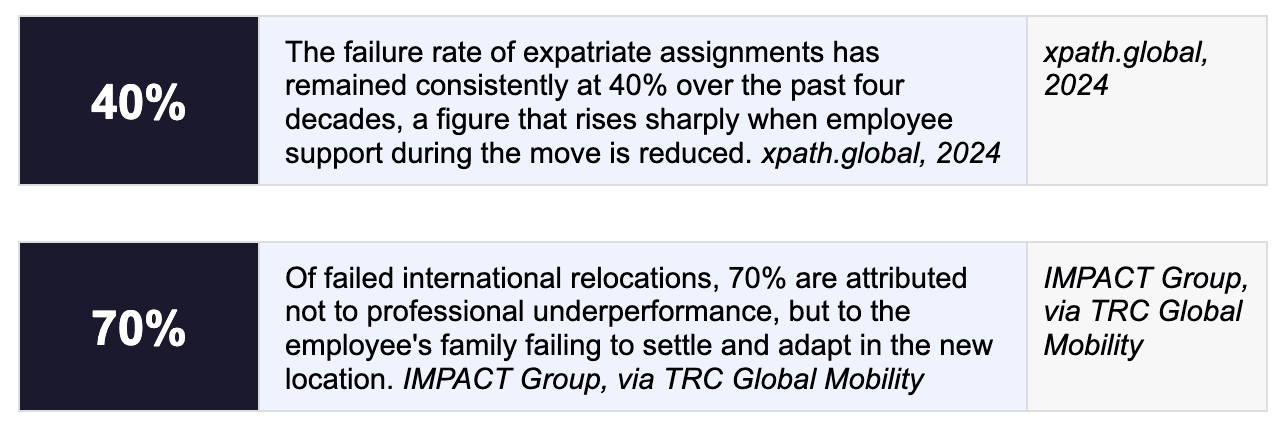
Survey data from 2024 indicates that approximately 68 percent of employees who receive a lump sum report moderate to significant stress during the planning and execution of their relocation. The drivers are remarkably uniform across markets, seniority levels, and move types:
Information asymmetry. The employee is making high-stakes decisions about customs regimes, transit insurance, household goods valuation, and destination housing markets in jurisdictions they have often never lived in. They lack the comparative data, local context, and vendor relationships that a competent RMC would routinely provide. They are, in structural terms, an uninformed buyer in a market built for repeat professionals.
Time compression. The average international assignment planning window has contracted from approximately 90 days in 2015 to under 60 days in 2024. Employees are being asked to make consequential logistical decisions in less time, with less institutional support, than at any point in the industry's modern history.
Unhedged downside. Under the master contract model, the employee is insulated from catastrophic outcomes: if the shipment is lost, delayed, or damaged, the corporate bears the contractual and financial consequences. Under the lumpsum model, the employee absorbs those consequences directly. The autonomy that lumpsum programmes promise is, in practice, the autonomy of an under-resourced actor making irreversible decisions in a high-friction market.
None of this is catastrophic in the aggregate. Most lumpsum moves conclude without major incident. But the systematic reduction in support quality is real and measurable, even if it does not appear on any corporate dashboard.
A growing number of mobility teams are beginning to recognise this gap. They are quietly layering optional support services back in that the lumpsum was meant to replace. It is a quiet acknowledgement that the model, in its purest form, may have transferred too much operational burden to employees who were never equipped to carry it.
The Moving Company: A Larger Market, at a Steeper Acquisition Cost
The most consequential economic shift in the lumpsum transition is happening on the supply side and it is one that most established moving companies are still underestimating.
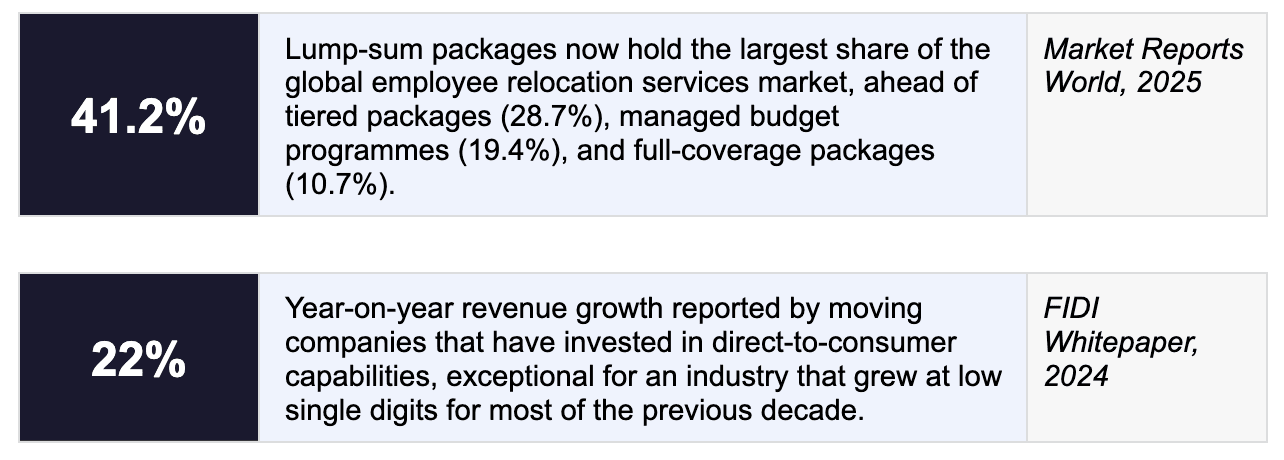
The headline opportunity is genuine. As corporate volume has migrated from contracted pipelines to lumpsum-driven direct demand, the addressable market for consumer-initiated international relocations has expanded substantially. Moving companies that have invested in direct-to-consumer capabilities are reporting year-on-year revenue growth of approximately 22 percent, according to the FIDI 2024 whitepaper. For an industry that grew at low single digits through most of the previous decade, that figure is exceptional.
The cost of capturing that revenue, however, is structurally different from what the master contract model required.
Under the old structure, a single business development manager, a senior relationship, and an annual contract renewal were sufficient to maintain a full pipeline from a key RMC client. The sales cycle was long; the acquisition cost per move was negligible. Under the lumpsum model, every individual expat must be found, acquired, qualified, quoted, and converted, one at a time, in a competitive comparison environment, frequently on the basis of price and online reputation.
The unit economics have inverted. Customer acquisition costs have risen sharply even as the average transaction value has remained broadly stable. Margins that appeared healthy under the master contract model are now under sustained, structural pressure.
This is not a crisis. It is a transition. The moving companies that recognise the change and invest now will emerge from the transition with both volume and margin intact. The ones that treat the old model as a baseline to which the market will eventually return will discover, too late, that the cost of standing still has compounded.

The RMC: Structural Disruption in the Middle of the Chain
The most exposed party in the lumpsum transition is, somewhat counterintuitively, the relocation management company.
For four decades, the RMC's value proposition rested on operational intermediation: aggregating demand, vetting vendors, managing complexity across multiple jurisdictions, and providing the corporate with a single accountable counterparty. This was genuinely valuable and, under the master contract model, genuinely defensible.
The lumpsum model, in its purest form, removes the need for that layer. The corporation no longer requires a coordinator because there is nothing to coordinate. The employee is, by design, self-managing. The mover no longer requires a channel partner because the relationship is now direct. The RMC sits in the middle of a transaction from which all three primary parties have, in principle, been liberated.
The strategic response from the major RMCs has been to migrate up the value chain where the lumpsum model does not directly compete. This is the correct strategic response, but it is not yet generating the revenue volumes that the old intermediation model produced. The margin conversion on advisory work is different from the margin conversion on logistics management, and the transition is neither fast nor frictionless.
The RMCs that will define the next phase of the industry are those that successfully reposition themselves as high-value strategic partners to corporate mobility functions, institutions that add analytical and compliance value that no platform and no individual employee can replicate. The ones that attempt to defend the old model by occupying a coordination role that the market no longer requires will find themselves bypassed by a supply chain that has simply reorganised itself around them.
Where the Money Is Actually Going
To understand the lumpsum economics in concrete terms, it helps to trace a typical transaction.
For a mid-career European relocation in 2025, the flow looks approximately like this:
Party | Amount |
Corporate pays lumpsum | €9,000 |
Mover receives (gross) | €5,500–€6,500 |
Platform / marketplace fee | €300–€600 |
Insurance, customs, ancillary services | €800–€1,200 |
Employee out-of-pocket costs | €0–€800 |
Employee underspend retained (or clawed back) | €0–€1,000 |
Industry estimates suggest that approximately one-third of corporate lumpsum programmes include clawback provisions, in which any unspent portion of the budget is returned to the employer rather than retained by the employee. This has significant implications for employee behaviour which we will examine in a future article in this series.
The picture this reveals is instructive. The apparent 30 to 40 percent saving on the corporate side is real, but it is not pure efficiency gain. A meaningful portion of it has been redistributed across a different set of parties: to movers, who must now invest in consumer acquisition; to platforms, which now sit structurally in the middle of the transaction; and to employees, who absorb a real workload that was previously carried by professionals whose time was already factored into the old cost structure.
The lumpsum has not created economic value. It has reallocated the cost of producing a relocation across a different set of actors. Whether that reallocation is more or less efficient than the old model is the central economic question of this transition and the early evidence suggests that the answer depends almost entirely on whether the new actors in the chain invest in the infrastructure required to make it function well.
The Question Facing the Industry in 2025

The lumpsum is not, as some industry voices have argued, a transient cost-control measure that will reverse itself once corporate mobility budgets recover. The structural forces driving it are not cyclical. They are durable.
The question for 2025 is not whether the lumpsum will become the dominant model. In most mature markets, it already is. The question is whether the new economic architecture will produce a relocation experience that is, in aggregate, better than the one it replaced or whether the savings will be quietly absorbed by friction, stress, and quality erosion that never appears on a corporate P&L but accumulates, invisibly, in the experience of the employees who live it.
That outcome will be determined, in large part, by the choices that moving companies make in the next 18 to 24 months. It is to those choices and to the infrastructure required to serve the new consumer-first reality, that the next article in this series will turn.



Fournisseurs
Plus de ce genre