The conditions that typically drive consolidation are already emerging in the moving industry. The operators caught in the middle have the least room to wait and see.
Every major structural transition in a mature industry eventually creates pressure for consolidation. Margins become harder to defend at the bottom, scale becomes more valuable at the top, and the operators in the middle face a choice: invest to compete at a different level or become part of a larger group.
The lumpsum transition is creating many of these conditions in the global moving industry.
The previous articles in this series have documented the forces behind that shift. Master contract revenue is migrating toward direct consumer channels. Customer acquisition costs have risen sharply. Digital visibility, review infrastructure, and pricing transparency have become structural requirements for competing in the consumer-facing market. Building those capabilities from scratch takes capital, management attention, and time, and many established operators do not have an abundance of any of the three.
What the earlier articles in this series did not address is what happens when those pressures land at once on an industry that remains highly fragmented. One increasingly plausible outcome is consolidation.
New to The Lumpsum Shift?
This is the tenth and final article in our series on how the shift from master contracts to employee-controlled relocation budgets is reshaping the moving industry.
Catch up on the rest of the series:
Why Are Corporates Ending Master Contracts with Movers? — The forces driving corporations away from the master contract model.
The Economics of the Lumpsum: Who Actually Benefits When the Money Changes Hands — A closer look at the winners, losers, and hidden costs of the new model.
The Mover's Dilemma: Why the Decisions Made in the Next 18 Months Will Determine Who Survives the Lumpsum Transition — The strategic choices moving companies now face.
The Mover's Playbook: A Practical Guide to Winning in the B2C Era — Practical actions movers can take to compete in an increasingly consumer-led market.
How to Manage Your Relocation Lumpsum: A Practical Guide for Expats — Everything expats need to know to make smarter relocation decisions and get the most out of their lumpsum.
Build, Buy, or Partner? The Strategic Decision That Will Define the Next Decade of Moving — How movers should choose between building, buying, or partnering for the consumer-facing capabilities they need to compete.
The Review Economy: How Online Reviews Became the New Master Contract for Movers — Why online reviews have become the new trust signal for movers competing in the consumer-led market.
Why Movers That Show Their Prices Convert More — Why price transparency helps movers build trust, reduce friction, and convert more consumers without competing on being the cheapest.
The Talent Gap: Why the Lumpsum Shift Requires a New Mix of Skills — How international movers can close the B2B-to-B2C talent gap and build the skills the lumpsum era demands.
Why the Lumpsum Transition Strengthens the Case for M&A
Consolidation happens in industries for many reasons. In the moving industry's case, the lumpsum transition is strengthening the case for it through four specific mechanisms.

Mechanism 1: The consumer acquisition cost problem
Under the master contract model, a moving company's primary commercial asset was its relationship with a relatively small number of institutional buyers. Maintaining those relationships required predictable investment in account management, industry events, and contract renewal.
In the consumer market, the equivalent investment is customer acquisition at scale: search engine optimisation, platform partnerships, review generation, rapid quote infrastructure, and digital conversion. These are not one-time costs. They are recurring expenses that must be sustained to maintain consumer visibility.
A large operator can spread that investment across significantly more moves. A mid-sized operator running on thinner margins in a capital-intensive business is competing for the same budget against fleet maintenance, warehouse costs, and operational headcount. The economics increasingly favour scale and when scale becomes more valuable, consolidation becomes more likely.

Mechanism 2: The review infrastructure moat
As we documented earlier in this series, the review profile is becoming the new master contract. Unlike the old master contract, a strong consumer review profile is accumulated one move at a time, over years of consistent execution. This creates a compounding advantage for operators that move early: a moving company with hundreds of reviews, a strong average rating, and active monthly review generation holds a consumer market position that a new entrant cannot replicate quickly.
That makes review infrastructure valuable not only commercially but strategically. For a potential acquirer, buying a company with an established reputation can be faster than trying to build that trust independently.
Mechanism 3: Geographic network effects
International moving is structurally a network business. The quality of a move from Amsterdam to Singapore is determined not only by the origin operator, but by the destination partner network, customs clearing relationships, and last-mile delivery capacity. A mover with a strong network of vetted destination partners owns an asset that is difficult to reproduce quickly.
The lumpsum transition is also making that network more visible to consumers, since customers increasingly evaluate moving companies directly rather than inheriting them from a corporate contract. Operators with strong geographic coverage and reliable destination networks are therefore likely to become more attractive acquisition targets for companies seeking to expand quickly into new markets.
Mechanism 4: Technology platform leverage
The consumer-facing moving market increasingly rewards operators that offer digital self-service. For some operators, acquiring a business that already has the infrastructure may be faster than building everything organically.
This is where private equity and other well-capitalised buyers could become increasingly important. The investment thesis is familiar from other fragmented service industries. The moving industry increasingly presents several of the conditions that make that strategy attractive.

Technology spend is accelerating on the corporate side. This raises the competitive pressure on movers to match it with their own digital infrastructure.
Who Will Buy Whom: Three Consolidation Scenarios
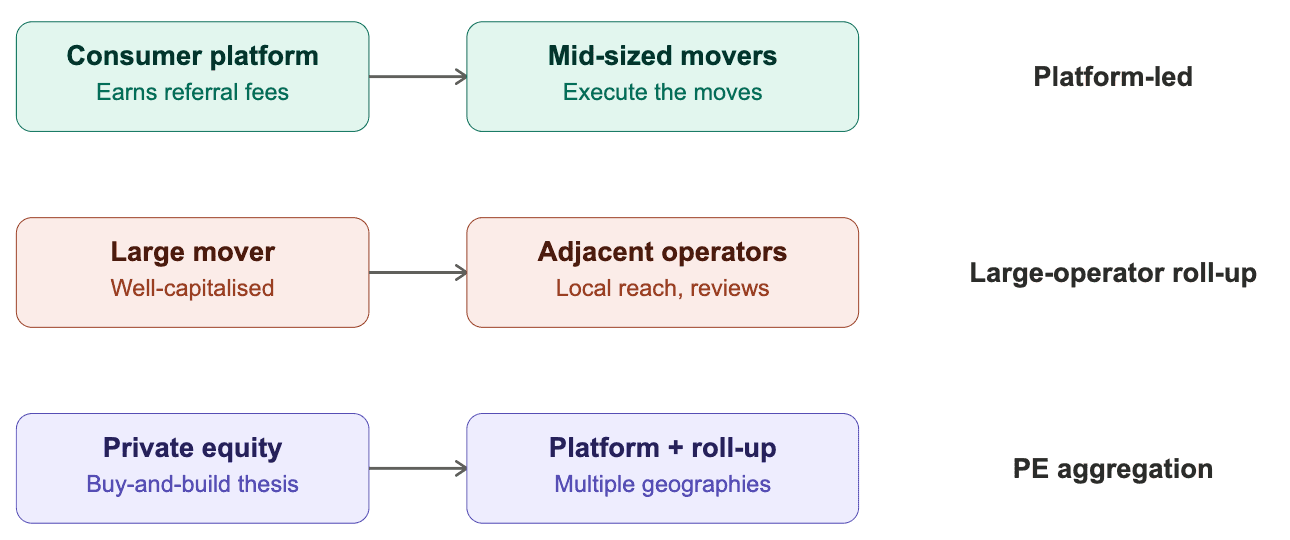
Consolidation in the moving industry is unlikely to follow a single pattern. Based on the structural forces above, three scenarios appear particularly plausible. Each with different implications for mid-sized operators.
Scenario 1: Platform-led consolidation
One possible near-term pattern is platform-led consolidation: a consumer-facing relocation platform begins acquiring or taking strategic positions in moving companies. The logic is straightforward: a platform that currently earns a referral or transaction fee per booked move may capture significantly more value if it owns part of the operation executing the move.
The consumer relationship, already established through the platform, becomes a larger owned revenue stream. The moving company gains access to demand; the platform gains margin, quality control, and greater influence over the customer experience. This is best understood as one plausible form of vertical integration created by the rise of consumer-facing relocation platforms, not an inevitability.
Scenario 2: Large-operator roll-up
The second scenario is more traditional: a large, well-capitalised moving company acquires mid-sized operators in adjacent geographies to extend its network reach and consumer market coverage.
The acquired operators bring local market knowledge, established destination relationships, operational capacity, and potentially strong review profiles. The acquirer brings capital, technology infrastructure, brand, and customer acquisition capability. The combination can produce a business more competitive in the consumer market than either party would be independently. This model is particularly attractive in markets where geographic fragmentation remains high and where building an operational network organically would take years.
Scenario 3: Private equity aggregation
The third scenario could produce the most significant structural change: private equity enters the sector with a buy-and-build thesis, acquires a platform or leading operator as the initial vehicle, and adds mid-sized operators across multiple geographies.
Several of the conditions typically associated with this strategy are present. The market is large and growing. The supply side remains fragmented, and that kind of uneven performance can create acquisition opportunities, particularly where otherwise sound operators lack the capital or capabilities to adapt independently. Technology and customer acquisition increasingly reward scale. Whether private equity enters the market aggressively remains uncertain, but the underlying economics make the possibility increasingly credible.

What Buyers Are Likely to Look For
If consolidation accelerates, different buyers will pursue different assets.
Buyer | Likely target | What they are primarily buying |
|---|---|---|
Consumer-facing platform | Strong regional mover | Operational control, margin and service quality |
Large international mover | Mid-sized operator in an adjacent geography | Network reach, local expertise and destination capacity |
PE-backed platform | Profitable, well-run mid-sized mover | Scale, cash flow and consolidation potential |
Technology-enabled mover | Traditional operator with strong operations | Volume, customer base and geographic coverage |
The common thread is that the most valuable acquisition targets will not necessarily be the largest operators. They will be the companies that own what is difficult to recreate quickly: reputation, geographic density, strong destination networks, operational quality, consumer visibility, and reliable management teams.
The Middle Is the Dangerous Place
The most exposed position in a consolidating industry is often the middle: too large to pivot quickly, too small to enjoy the scale advantages that make major investment in technology and consumer acquisition easier to absorb.
For the moving industry, the middle is a well-populated place. It contains many established operators that built successful businesses around institutional relationships and operational expertise.
That does not mean these companies are destined to disappear. It means they need to decide what role they want to play before market pressure makes that decision for them.
What Mid-Sized Movers Must Do Before the Wave Arrives
For a mid-sized moving company, there are three credible strategic positions.
Position 1: Become an acquirer
The operators best placed to emerge from consolidation as acquirers are those that have already made meaningful progress in the consumer transition. Those businesses may have an opportunity to acquire smaller operators in adjacent markets and extend their geographic coverage without building every capability from scratch.
The practical actions are straightforward: identify attractive geographic adjacencies, define a clear acquisition thesis, and begin building relationships with potential targets before competitive processes make those assets more expensive.
Position 2: Become an attractive acquisition target
Operators that do not intend to become consolidators have another viable strategy: become the most attractive acquisition target in their market. That does not mean preparing the company for distress. It means strengthening the assets a strategic buyer is likely to value.
A well-run operator with growing direct-to-consumer revenue, strong consumer visibility, and a defensible geographic position is likely to have significantly more negotiating power than a company that waits until declining revenue forces a transaction.
Position 3: Find a strategic partner before a transaction becomes necessary
The third option is partnership. A consumer-facing platform, a network alliance with complementary operators, or a technology-sharing arrangement can provide some of the benefits of consolidation without requiring a full change of ownership. For many mid-sized movers, this may be the most realistic route.
Timing matters here. The value of a strategic partnership is highest when both parties are negotiating from positions of strength. If one party waits until it urgently needs distribution, technology, or demand, the balance of negotiating power shifts against it.
The Consolidation Wave Is Not Only a Threat. It Is a Strategic Choice
Framing consolidation purely as a threat misses the more important point: for well-positioned moving companies, it can also create opportunity.
Some operators will become acquirers. Others will become highly attractive acquisition targets. Others will use partnerships to remain independent while gaining access to capabilities they cannot efficiently build themselves.
Size, capital, and geography will shape the options available. But the factor management teams can control is how early and deliberately they choose their position.

Companies that approach that window with strategic clarity will have more options when the market changes. Those that wait until consolidation is obvious may find that many of those options have already been defined by someone else.
This is the final article in The Lumpsum Shift series. Over ten instalments, the series has examined the structural forces driving the transition from master contracts to lumpsum programmes, the economic consequences for every party in the supply chain, and the strategic choices that will shape the next decade of the moving industry.
The transition is real. The opportunity is still open. The question now is what position each operator chooses to take.



Fournisseurs
Plus de ce genre