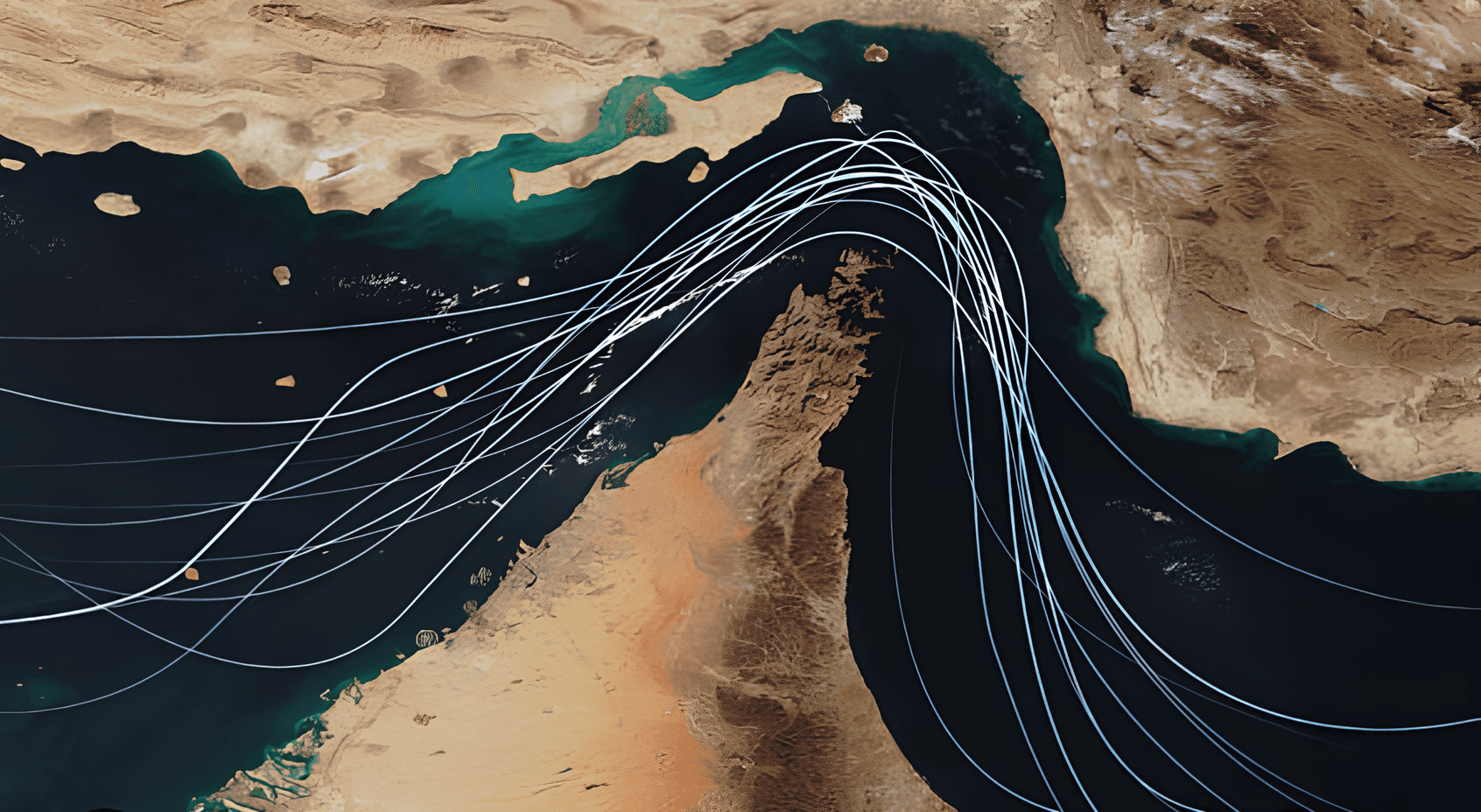

If you're handling international relocations right now, you're operating in a fundamentally different logistics environment than six months ago. Freight rates are up. Transit times are longer. Container slots are harder to secure. And many of your clients are still budgeting based on last year's world. That gap is yours to close, before a competitor does, or before a delay does it for you.
A strait your clients have never heard of and can't ignore
The Strait of Hormuz, a narrow waterway between Iran and Oman, has been effectively closed since early 2026. Nearly 90% of traffic that previously transited the Suez and Gulf route now sails around the entire African continent. This isn't a temporary detour, it is the 2026 baseline. Ships add up to 4,000 extra nautical miles per voyage, and every cost downstream reflects that reality.
What Happened, A Crisis the World Never Heard Of
January 2026 — Strait Effectively Closed Regional tensions force initial diversions. Carriers begin Cape of Good Hope contingency routing. |
February 2026 — War Risk Premiums Triple Underwriters reassess Gulf exposure. Pass-through surcharges appear on nearly every international quote almost overnight. |
March 2026 — 90% Rerouted via Africa Cape routing becomes the operational standard. Fuel consumption rises 38%, prompting carriers to implement Emergency Bunker Surcharges (EBS). |
April 2026 — Blank Sailings & Port Backlogs Carriers cancel 13% of scheduled sailings to stabilize rates. Containers wait at ports for up to 14 additional days, even after payment. |
May 2026 — New Baseline Confirmed On-time delivery falls to 48%. Transit times are 20–25 days longer than a year ago. The Cape route is no longer a crisis measure, it has become the new normal. |
The Numbers
|
|
|
|
Transit Times
Corridor | 2025 Average | May 2026 | Change |
|---|---|---|---|
Europe → Middle East | 18–22 days | 32–38 days | +24 days |
Europe → South Asia | 22–26 days | 38–44 days | +20 days |
Europe → Southeast Asia | 24–28 days | 40–50 days | +28 days |
Intra–Middle East | 8–12 days | Disrupted | Variable |
Cost Impact — Three Surcharges Hitting Every Quote
Emergency Bunker Surcharge (EBS)$650–900 per unit MSC and Maersk are implementing EBS to offset the 38% fuel increase. | War Risk Insurance3× 2025 levels Insurance premiums have tripled since January, creating a direct pass-through cost on every international quote. | Blank Sailing Delay+14 days Even a paid booking may remain at port for an additional two weeks if the scheduled sailing is cancelled. |
"Clients who've budgeted time around an old baseline are setting themselves up for a difficult arrival. The movers who set accurate expectations upfront are the ones who get good reviews."
Surcharges are the new base rate
The Drewry index base rate looks manageable, but the all-in cost for every container tells a different story. Three specific May 2026 levies are reshaping what you quote. Any price issued more than four to six weeks ago must be revalidated before a client commits. That conversation is better coming from you than from a competitor spotting the discrepancy.
Stop quoting final prices. Switch to Market-Adjusted Rates valid for 14 days maximum. It protects your margin, and it creates genuine urgency, the client understands the market moves fast.
Capacity Hotspots — May 2026
Indian Ocean / GulfTighter than usual. Capacity is being diverted to cover extended Indian Ocean loops. Network access is a competitive advantage. | Portugal / IberiaRelatively stable but suffering from a severe empty-container shortage. Containers are tied up on 55-day voyages to Europe. FCL leverage through carrier relationships matters. |
Northern EuropeShips departing Europe are arriving via the Cape of Good Hope, later and with less predictability. A ~19% price increase was recorded in May. | Southeast AsiaPort congestion at Singapore and Tanjung Pelepas is extending dwell times by 5–9 days. Additional quote buffers are recommended. |
Two-speed relocation, the upsell that actually solves a problem
With sea freight on-time reliability at 48%, your clients are genuinely afraid of arriving at an empty home. The most successful movers in 2026 are not selling a single container, they are selling a two-speed solution. Air cargo rates have stabilised at $2.50–$2.80/kg. A 150 kg air "survival shipment" of essentials arrives in 7 days, giving a family a functioning home while the sea container rounds the Cape.
The hybrid model works. If you can offer it as a structured option, rather than waiting for the client to ask, you are providing genuine value and differentiating on something that matters right now.
The Opportunity — Two Speeds That Actually Drive Pipeline
Sea Freight LCL Container50–58 days The primary option for transporting household goods. Set expectations around Cape routing, port delays, and the current 48% on-time delivery rate. Maintain proactive communication and provide frequent tracking updates throughout the shipment journey. | Air Freight the Essentials 150 kg5–7 days Ideal for clothing, documents, and high-value items. Estimated cost: $2.50–$2.90/kg. This option sells certainty in a market where certainty is scarce, particularly for families with fixed relocation dates or immediate arrival requirements. |



Verkäufer
Mehr davon