

In the first three articles of this series, we examined a structural transition the global moving industry can no longer defer. The master contract model is contracting. The lumpsum has reallocated economic value across the supply chain. The performance gap between moving companies that have adapted to the B2C environment and those that have not is already substantial, is widening, and will not narrow.
The previous article reduced the strategic landscape to five high-leverage decisions: channel diversification, digital visibility, pricing transparency, operational flexibility, and brand investment. It closed with a warning. The window in which those decisions can be made from a position of relative strength is approximately eighteen to twenty-four months. After that, the assets that define consumer market leadership will have been claimed by the operators that moved first.
This article is the practical companion to that warning.
It is not an analysis. It is a playbook.
Drawing on the FIDI whitepaper, on interviews with senior leaders at twelve mid-sized moving companies that have navigated the consumer transition successfully, and on Relocately's own data covering thousands of consumer-initiated moves, what follows is a concrete guide for moving company leaders ready to act in the next ninety days. It is organised around the five strategic decisions from the previous article, translated into specific moves, sequencing, and measurable outcomes.
It is not a complete transformation plan. It is, however, a credible starting point and a credible starting point is what most of the industry is currently missing.
Decision 1: Channel Diversification
The first decision is, in practice, less a question of arithmetic than of organisational clarity.
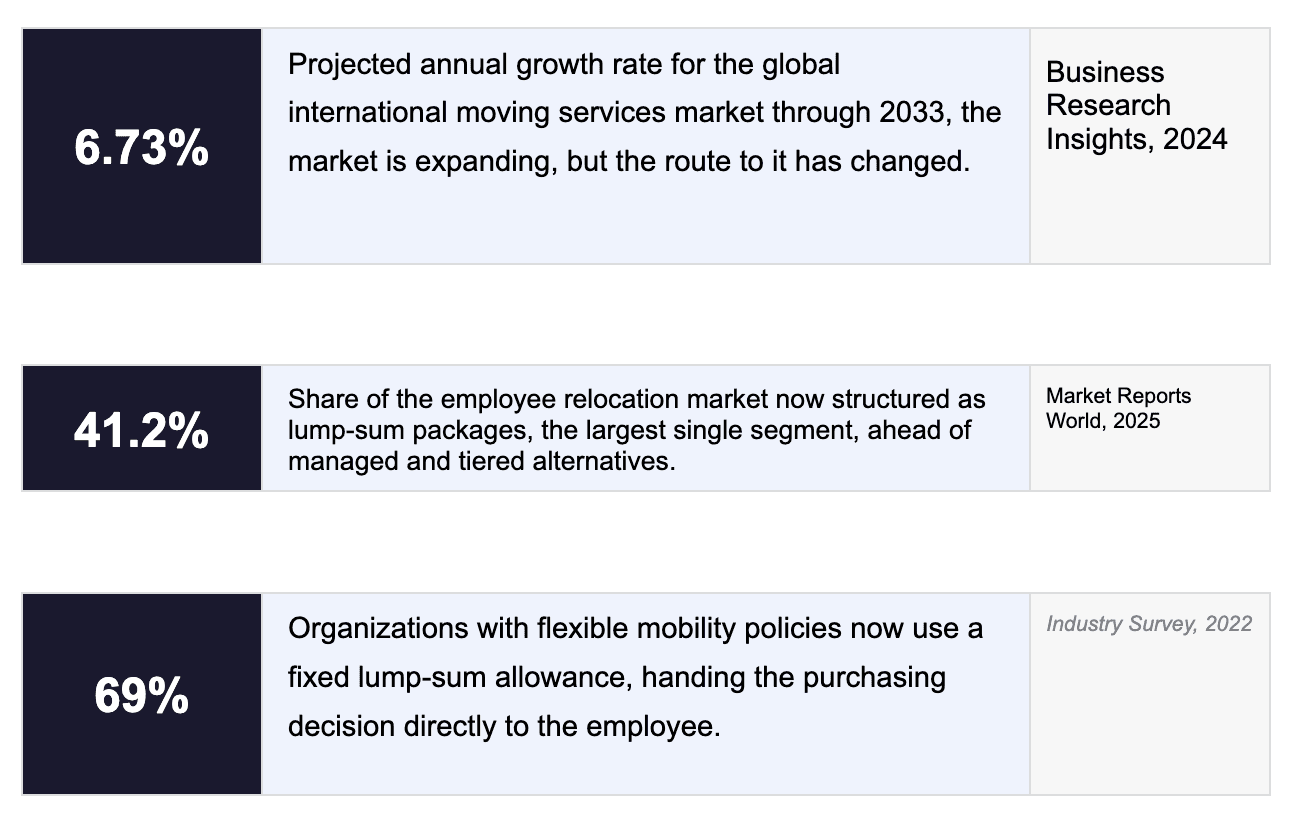
The moving companies in our sample that have managed the channel transition most successfully share one common trait: they have assigned explicit revenue targets to the consumer channel, with the same rigour and accountability that the institutional channel has historically received. The consumer channel is not an experiment. It is not a side project. It is a strategic priority, and the leadership team is measured on it.
The 90-day move: Assign a single executive sponsor for the consumer transition. Not a committee. Not a working group. A named individual with a quarterly revenue target for the consumer channel and the authority to reallocate resources toward it.
The moving companies in our sample that took six to nine months to gain traction in the consumer channel share a different common trait: the consumer transition was everyone's responsibility, which meant it was no one's. The named executive sponsor is, in itself, a strategic signal. It tells the organisation that the consumer channel is not optional.
What to measure:
Consumer channel revenue as a percentage of total revenue, tracked monthly
Quote-to-conversion rate for consumer-initiated inquiries, by source (organic search, platform referral, direct)
Customer acquisition cost per booked move, benchmarked against the institutional channel's effective acquisition cost
A useful diagnostic: if the consumer channel represents less than 15 percent of revenue at the end of ninety days but is growing faster than the institutional channel, the transition is on track. If it is growing at the same rate, the transition is at risk.
Decision 2: Digital Visibility
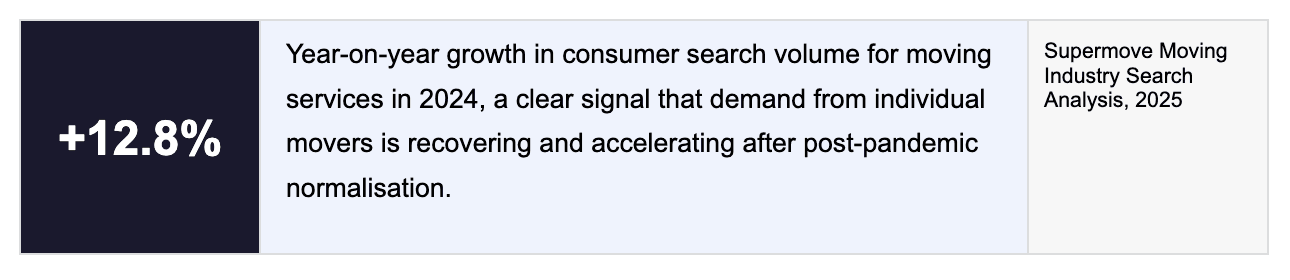
In a B2B environment, visibility to the institutional client is a relationship function. In a B2C environment, visibility to the expat is a search, content, and reputation function and it is, fundamentally, an asset that compounds. Every positive review, every well-optimised service page, every quote delivered promptly is a small increment in an asset base that becomes progressively more difficult for competitors to displace.
The capital required to begin building this asset is modest. The management attention required is not.
The 90-day moves:
Audit your digital presence with brutal honesty. Most moving companies significantly overstate the quality of their own visibility. The diagnostic is straightforward: open an incognito browser, search for "international movers" plus your three primary destination cities, and count how many results feature your company on the first page. If the answer is fewer than three, the digital visibility gap is the primary constraint on consumer growth, and should be treated as such.
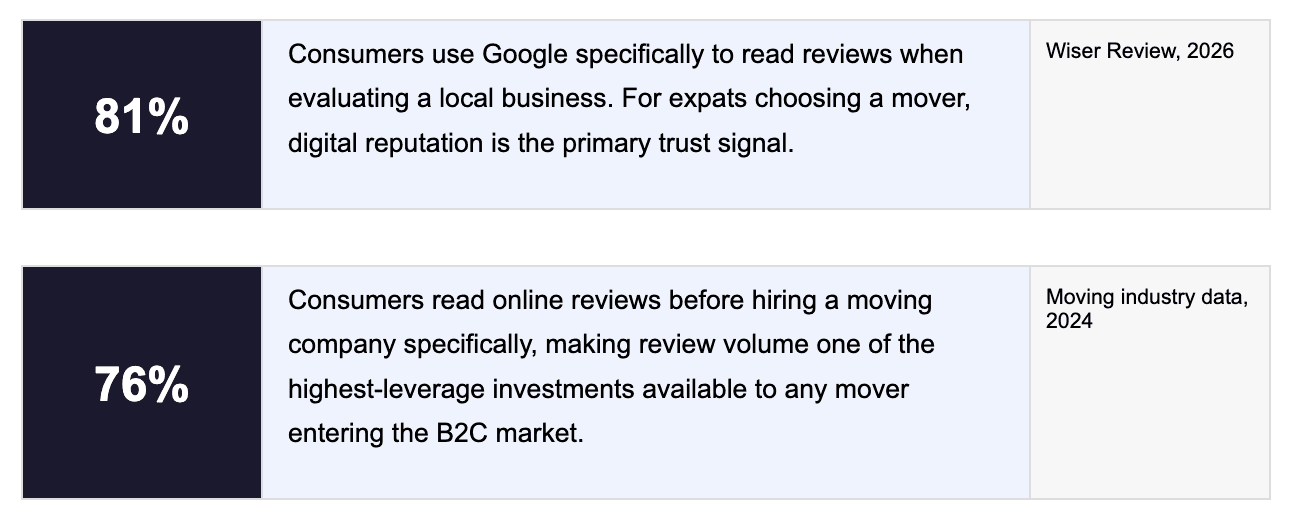
Establish a review generation discipline. The moving companies in our sample with the strongest consumer trajectories share one operational habit: they systematically request a review from every completed move, with a defined cadence and a direct link to the review platform. Review volume is the most legible proxy for service quality in a consumer market. It is also one of the slowest assets to build and one of the fastest to lose.
Partner with at least one consumer-facing platform before the end of the quarter. The leading adaptors in the FIDI data did not build their consumer presence from scratch. They accelerated it through platform partnerships that provided immediate access to search visibility, review infrastructure, and quote-response capability. For a mid-sized mover, the question is not whether to build or buy. It is how quickly the decision to partner can be made.
What to measure:
Review volume and average rating across the platforms that matter to expats (Google Business Profile, Trustpilot, and relevant industry-specific platforms)
Organic search ranking for the ten highest-intent search terms in your operating regions
Quote response time, the median time between an inbound consumer inquiry and a delivered quote
On that last metric: the leading adaptors in our sample respond to consumer inquiries in under four hours during business hours. The laggards take more than 24. The expat comparing three to five options simultaneously does not wait.
Decision 3: Pricing Transparency
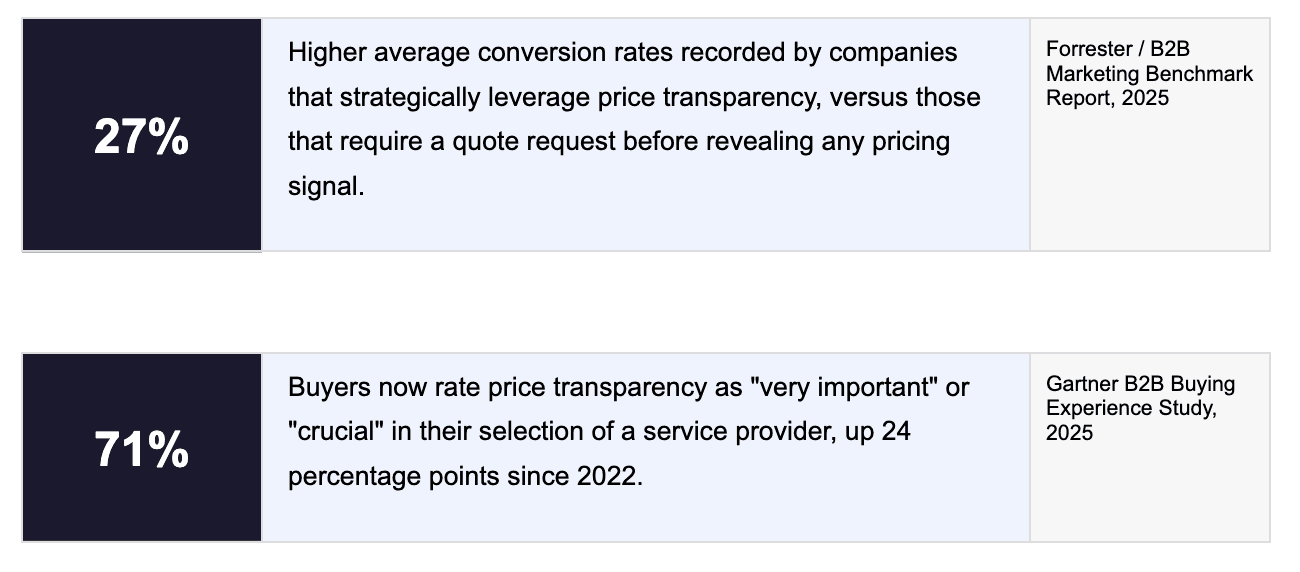
The expat managing a lumpsum-funded move is operating under time pressure, with limited knowledge of the international moving market, and with a hard budget ceiling. The traditional sales-led quote process is structurally misaligned with how this customer makes decisions.
The 90-day moves:
Define three pricing tiers. The leading adaptors have converged, with remarkable consistency, on a three-tier structure: an Essential tier (origin or destination services only, for the expat who has arranged the other half); a Standard tier (full door-to-door with standard transit times and baseline insurance); and a Full-Service tier (premium transit, enhanced insurance, packing and unpacking, short-term storage). The tiers are not the complete pricing structure. They are the entry point, the framework that lets a consumer self-select a product and form a price expectation before requesting a detailed quote.
Publish starting prices for each tier on your website. Not exact quotes. Starting prices. The function of a starting price is to shift the consumer's decision from "should I request a quote?" to "which tier should I request a quote for?", a small change with a disproportionate effect on conversion. Moving companies that require a quote request before revealing any price information are filtering themselves out of the consideration set before the conversation begins.
Train the commercial team on consumer selling. The institutional sales process is a different discipline from consumer sales, which is short cycle, transaction-led, and decided primarily on trust, transparency, and response speed. The institutional sales muscle does not transfer to the consumer environment without deliberate practice.
What to measure:
Quote request rate from the website after publishing starting prices
Tier-mix distribution: what proportion of consumer inquiries select each tier
Quote-to-booking conversion rate by tier
Decision 4: Operational Flexibility
The master contract model produced moving companies optimised for large, complex, infrequent, high-revenue moves. The consumer market is defined by smaller, more frequent, more price-sensitive individual transactions. The operational implications are significant and, for traditional operators, structurally uncomfortable.
The 90-day moves:
Map the fully-loaded cost of a consumer move versus an institutional move. Most moving companies, when they do this exercise for the first time, find that the per-move cost of a consumer-initiated move runs significantly higher than an institutional move at comparable revenue. The drivers are typically: more customer service contacts, more custom configurations, less predictable origin-destination combinations, and higher handover costs between sales and operations. The map is not a plan. It is a diagnostic that makes the reorganisation imperative visible to leadership.
Identify two to three operational changes that reduce per-move cost without degrading service quality. The most common high-leverage changes in our sample: standardising the consumer move coordination workflow around a small number of recurring move archetypes rather than treating each move as bespoke; implementing self-service tools (online booking, live status tracking, document upload) that reduce inbound customer service volume; and renegotiating destination service partner agreements to introduce volume-based pricing that scales with consumer throughput.
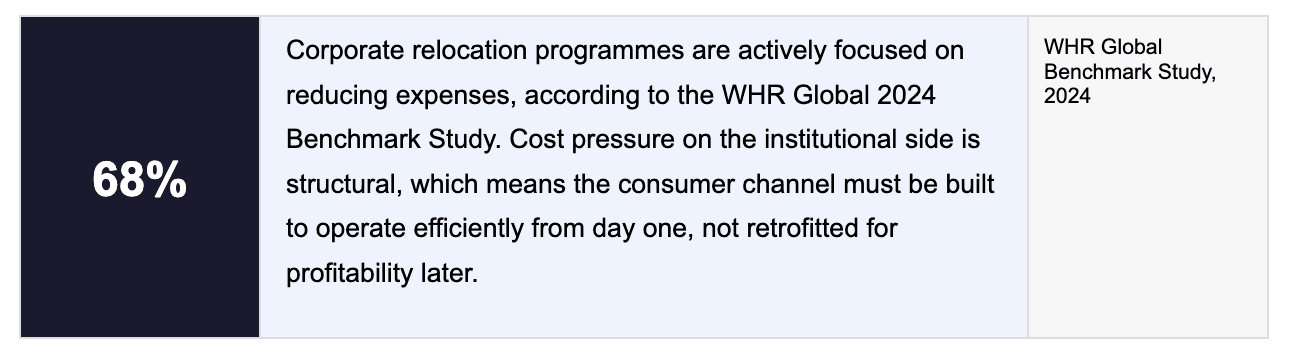
Set a per-move cost target for the consumer channel. A benchmark drawn from leading adaptors in our sample: target a per-move cost within 15 to 20 percent of the institutional channel benchmark by the end of year one. This is achievable through the changes above, and it is the threshold at which the consumer channel becomes structurally profitable rather than structurally subsidised.
What to measure:
Per-move cost for consumer versus institutional moves, tracked monthly
Customer service contacts per move a leading indicator of operational cost
Self-service adoption rate among consumer customers
Decision 5: Brand and Reputation
In a consumer market, reputation is not conferred. It is accumulated, one review at a time, in public, by individual customers who have no institutional obligation to be charitable. And it compounds in both directions.
The moving companies in our sample with the strongest consumer brand equity share one organisational habit: the CEO or managing director reviews the company's public reputation monthly, responds personally to negative feedback, and is visibly accountable for its trajectory. Reputation is treated as a C-suite concern, not a marketing department function.
Implement a service recovery protocol for negative reviews. Every consumer-facing business accumulates negative reviews. The variable is not whether they appear, but how the company responds. A negative review that receives a prompt, specific, and accountable response within 24 hours is associated, in our sample, with a higher average rating over the subsequent six months than a profile with no negative reviews at all. Service recovery is, paradoxically, one of the highest-leverage brand investments available.
Publish a thought leadership position. The leading adaptors have, with remarkable consistency, invested in published content that positions the company as a knowledgeable partner rather than a transactional provider. The cost is modest. Relocately's data suggests that moving companies with a published thought leadership presence convert consumer inquiries at 30 to 40 percent higher rates than those without one.
What to measure:
Review volume, average rating, and recency across platforms, reviewed monthly
Negative review response time: target under 24 hours during business days
Branded search volume consumers searching for the company by name, as a proxy for brand recognition
Three Moves You Can Make This Week
Some of the actions above require planning, investment, and organisational change. Three do not. For moving company leaders ready to act immediately, the following can be executed within seven business days, at no significant capital outlay:
1. Open an incognito browser and search for your company on Google, Trustpilot, and your two most important destination cities. Document exactly what you find. This is your baseline. Most leaders are surprised by what they see.
2. Send a review request to every customer who completed a move in the last 30 days. Use whatever tool you already have. A direct link to your Google Business Profile, a templated email sent within 48 hours of delivery, is the entire protocol.
3. Publish three starting prices on your website for your three most common service configurations. Approximate ranges are sufficient. Any price signal is meaningfully better than none.
None of these moves is transformative in isolation. Together, they signal that the consumer transition has begun.
The Four Common Mistakes
In the course of this work, four recurring mistakes stand out. Each is avoidable.
Treating the consumer channel as a marketing project. Marketing projects get budgets. Strategic priorities get executive attention. The difference in outcome is not marginal.
Competing on price. The leading adaptors are not the cheapest operators in their markets. They are the most legible, the most responsive, and the most trusted. Competing on price is a race to the bottom that the consumer market rewards briefly and punishes structurally.
Underinvesting in customer service. For the expat, an international move is one of the most stressful transactions of a given year. Customer service quality is the single most important driver of review scores, repeat business, and word-of-mouth referral. Companies that treat it as a cost centre consistently underperform in the consumer market.
Waiting for the institutional channel to fully contract before acting. The leading adaptors used a still-intact institutional revenue base to fund the consumer transition. The companies that waited are now attempting the same transition from a position of contracting revenue, with less cash, less organisational energy, and a narrower window. The strategic logic of timing has not changed.
A Note on Sequencing
The five decisions above are not executed in parallel. They are sequenced.
The foundational decision is channel diversification, without an executive sponsor and a revenue target, the other four lack organisational traction. With that foundation in place, the next priority is digital visibility, the asset that compounds the fastest. The third is pricing transparency, which produces the most immediate conversion effect. Operational flexibility and brand investment are parallel workstreams that begin in the second quarter and continue through the first year of the transition.
The moving companies in our sample that followed this sequencing completed meaningful consumer transition milestones within twelve months. Those that attempted all five simultaneously completed none of them.
The Next Conversation
The moves in this playbook are a starting point, not a complete answer. They are, however, sufficient to begin and beginning, in this transition, is the variable that matters most.
The conversation the industry most needs to have in the next twelve months is not about whether the lumpsum transition is real. That question has been settled. It is about whether moving companies can execute the transition with the speed, the discipline, and the strategic clarity the moment requires.
That is the purpose of The Movers' Roundtable, the private community for moving company leaders navigating this transition in real time. It is also, in a more structured form, the purpose of the Relocately platform: to provide the consumer-facing infrastructure, the data visibility, and the operational tools that allow established moving companies to compete in the B2C market from day one, without building from scratch.
The lumpsum transition is the most significant structural change the global moving industry has faced in forty years. The playbook above is a credible starting point. The next move is yours.



Verkäufer
Mehr davon