
For a decade, the answer was simple: Dubai. Zero tax, world-class infrastructure, year-round sun. Then came the missiles. Since Iran began striking U.S. allies in the region in late February 2026, tens of thousands of expatriates have been quietly packing bags and reassessing everything. Here's what the data shows, and where people are actually going.
30K+ | −23% | 88% |
In this article
Why Dubai is no longer the default expat choice
The destinations gaining momentum in 2026
The hidden shift behind today’s relocation decisions
Why safety is replacing tax as the key driver
The questions you should ask before your next move
What changed in 2026
The UAE sits just across the Strait of Hormuz from Iran, a fact most Dubai expats had quietly set aside for years. The city had built its entire brand around being the one place in the Middle East that was above the region's instability. That brand took a serious hit when missile interceptions began lighting up the night sky over Palm Jumeirah.
Major international banks ordered staff to work from home. Goldman Sachs, Citi, and Standard Chartered pulled employees from their Dubai offices. Beach clubs went quiet. Restaurants that normally buzz with international chatter saw footfall drop sharply. And the conversation inside the expat community shifted to something far more basic: is this still where I want to be?
"Dubai's appeal was never solely financial. It sought to attract Westerners with the promise they could enjoy Middle East opportunities without Middle East instability."
The UAE authorities moved quickly to reassure residents. They began preparing to ease the 183-day tax residency rule for those who had temporarily left during the conflict, a signal that they understood the stakes. But retention has proven difficult. The people who are leaving are not simply going on holiday. Many are making permanent decisions.
Rethinking your next move? Explore safer destinations and compare trusted relocation options with Relocately.
Where people are going, rising destinations
Here's what's striking: most people leaving Dubai are not going home. For many Western expats, returning to their country of origin would trigger immediate tax liability on assets built up abroad. So instead of heading straight back, many are routing through new bases entirely.
🇮🇩 Bali, Indonesia (TOP PICK) The most discussed alternative among Dubai expats exploring Southeast Asia. Indonesia's geopolitical neutrality, distance from the Gulf, and expanding visa infrastructure have transformed what was once a holiday island into a serious long-term base. Key advantages:
|
🇵🇹 Portugal (RISING FAST) For those who prioritize EU stability and rule of law over financial optimization, Portugal has become the default European landing pad. Lisbon and Porto have active tech and entrepreneur communities, and the D7 passive income visa is accessible at €870/month. Key advantages:
|
🇹🇭 Thailand (RISING FAST) Bangkok and Chiang Mai have long been expat favorites, but the Gulf conflict has accelerated the move. Thailand’s digital nomad visa, strong international school infrastructure, and high quality of life at relatively low cost make it a compelling Dubai alternative for remote workers. Key advantages:
|
🇪🇸 Spain (TRENDING) Málaga has emerged as the surprise expat hub of 2025–2026, drawing a wave of tech workers and remote professionals seeking a Mediterranean lifestyle without Middle Eastern uncertainty. Barcelona continues to attract international entrepreneurs despite Spain’s income tax rates. Key advantages:
|
🇨🇭 Switzerland (STABLE CHOICE) Not a cheap option—but for high-net-worth individuals seeking geopolitical neutrality, strong financial infrastructure, and rule of law, Switzerland is the obvious transition base while the Gulf situation stabilizes. Key advantages:
|
🇨🇴 Colombia & Latin America (COST LEADER) For remote workers and location-independent entrepreneurs willing to accept a different lifestyle trade-off, Latin America offers something no other region can match on cost. Medellín, Mexico City, and San José (Costa Rica) are all reporting record interest from Gulf expats. Key advantages:
|
Where people are leaving, falling destinations
 Dubai, UAE (EXODUS) Dubai is not collapsing — it remains a 10.24-million-person economy built almost entirely on expatriate labor and capital, and its institutional resilience should not be underestimated. But something harder to rebuild than a runway has been damaged: the perception of Dubai as the one place where you could have Middle Eastern opportunity without Middle Eastern risk. Key indicators:
|
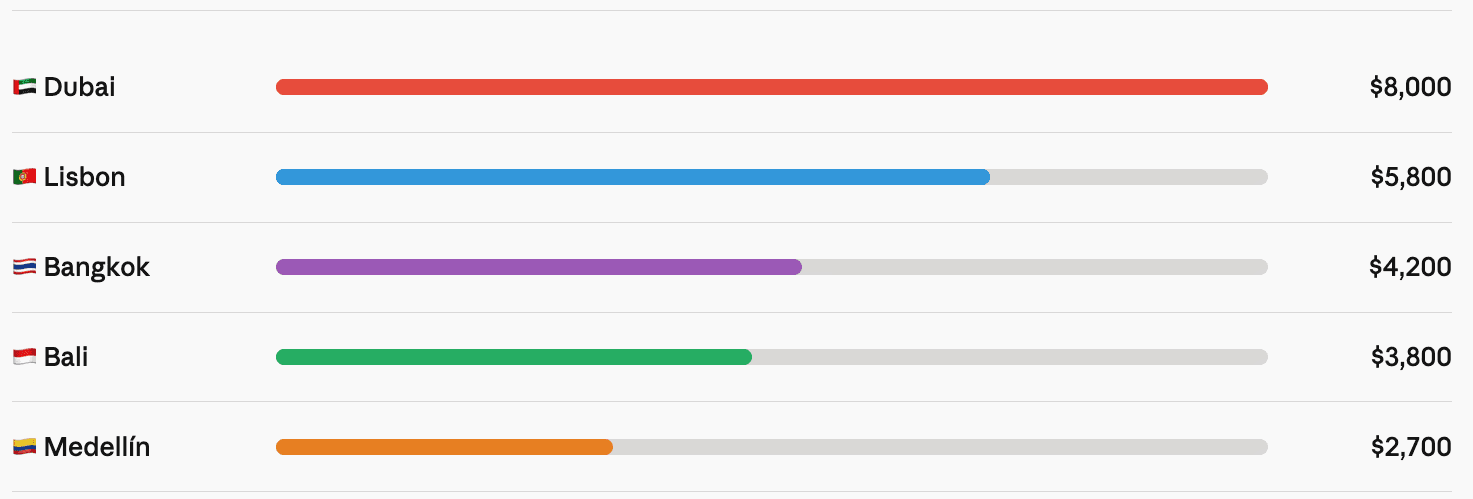
Monthly lifestyle budget for a family of four
What expats are actually optimizing for now
For years, the primary variable in any expat decision was the tax rate. Everything else mattered, but the spreadsheet always started at the top: how much do I keep?
Dubai won that competition comprehensively. And for ultra-high-net-worth individuals, it still does, those with enough assets to absorb geopolitical risk as a line item haven't moved. But for the broader professional class, the framework has quietly shifted. Safety and predictability have moved from background assumptions to active variables. A place that requires you to check air-defense alerts before going to dinner has, for many people, crossed a psychological threshold that no tax rate can offset.
"Expats are no longer optimizing for the lowest tax rate. They're optimizing for certainty and safety has become the new zero-tax."
This shift is reshaping entire industries. Relocation consultants are rewriting their pitch decks. International schools in Lisbon, Bali, and Bangkok are reporting record inquiries. Tax advisers are fielding calls about jurisdictions they rarely discussed two years ago. The global competition for mobile talent has entered a new phase and the rules have changed.
3 questions to ask before you moveWhat expats are actually optimizing for now
For years, the primary variable in any expat decision was the tax rate. Everything else mattered, but the spreadsheet always started at the top: how much do I keep?
Dubai won that competition comprehensively. And for ultra-high-net-worth individuals, it still does, those with enough assets to absorb geopolitical risk as a line item haven't moved. But for the broader professional class, the framework has quietly shifted. Safety and predictability have moved from background assumptions to active variables. A place that requires you to check air-defense alerts before going to dinner has, for many people, crossed a psychological threshold that no tax rate can offset.
"Expats are no longer optimizing for the lowest tax rate. They're optimizing for certainty and safety has become the new zero-tax."
This shift is reshaping entire industries. Relocation consultants are rewriting their pitch decks. International schools in Lisbon, Bali, and Bangkok are reporting record inquiries. Tax advisers are fielding calls about jurisdictions they rarely discussed two years ago. The global competition for mobile talent has entered a new phase and the rules have changed.
3 questions to ask before you move
1. When does my tax residency actually change?
Most countries require you to spend fewer than 183 days on home soil, but the threshold varies, and the UAE has now introduced flexibility during the conflict period. Understand your exact clock before booking flights.
Spending too many days back in your home country before establishing a new residency could trigger a tax bill you weren't expecting.
2. What triggers a taxable event when I leave?
Selling assets, dissolving a company structure, or simply changing your domicile can crystallize gains that were otherwise deferred.
Know what you'd owe before you move—not after. Many expats are surprised to discover that a move they thought was financially neutral comes with a significant cost when assets are properly accounted for.
3. Does my destination have a tax treaty with the UAE?
The UAE has signed over 130 double taxation agreements. Your next country may have one too—which could protect income streams you've built while in Dubai.
Ask specifically about:
Dividends
Rental income
Capital gains treatment
This one question can save you a significant amount of money during the transition.
If you're sitting with this decision right now
You may have built years of your life in Dubai, your network, your routines, your children's schools, your sense of normal. The idea of uprooting all of that isn't just a financial calculation. It's a deeply personal one.
What the data tells us is that you're not alone. Thousands of people across dozens of nationalities are sitting with the same uncertainty right now: whether to stay and wait it out, or use this moment as the push they needed to build something different somewhere new. Neither choice is wrong. Both take courage.
What the data also tells us is that the world has more good options than it used to. The rise of remote work, digital nomad visas, and global banking infrastructure means the "Dubai or bust" calculus has quietly dissolved. The question isn't whether you can have a good life somewhere else. It's what kind of life you want and what certainty is worth to you.
Wherever you decide to go next, Relocately helps you compare reliable movers and plan your relocation with clarity and confidence



Commencez maintenant
Plus de ce genre