You finally got around to requesting a moving quote. You compared a couple of companies, picked a number that felt manageable, and set it aside while you sorted out lease dates and packing boxes. Then, a few weeks later, you went back to confirm, and the price had changed.
This isn't a bait-and-switch. It's just how the moving industry works in 2025. And if you're planning a relocation, understanding why quotes expire so fast is the single most important thing you can do before you commit.
In this article
Why your moving quote might already be outdated
What’s really causing prices to change so quickly
The difference between binding and non-binding estimates
The mistakes that lead to unexpected costs
How to secure a price you can rely on
The Quote Shelf Life Is Shorter Than You Think
Most residential moving estimates are only valid for 7 to 30 days, depending on the company and the type of estimate. After that window, the numbers on the page are essentially a starting point for a new conversation.
The reason isn't arbitrary. Moving costs are composed of several volatile inputs like fuel, labor, materials, and logistics; and any one of them can shift meaningfully in the span of a few weeks. A quote that was accurate in early April may genuinely no longer reflect what it costs to move you in June.
Fuel Surcharges Reset, Often Weekly
One of the least understood parts of any moving estimate is the fuel surcharge, and it's one of the most volatile.
For household goods moves, fuel surcharges are typically tied to published diesel price indexes from the U.S. Department of Energy. Many carriers update these surcharges monthly; some do it every two weeks; others, like large freight carriers, adjust them weekly based on EIA national averages.
What this means practically: a long-distance move quote issued today may embed a fuel surcharge based on this week's diesel price. If you move six weeks from now, you could be paying a different rate entirely, higher or lower, but rarely the same.
Prices Have Climbed Significantly Since 2020
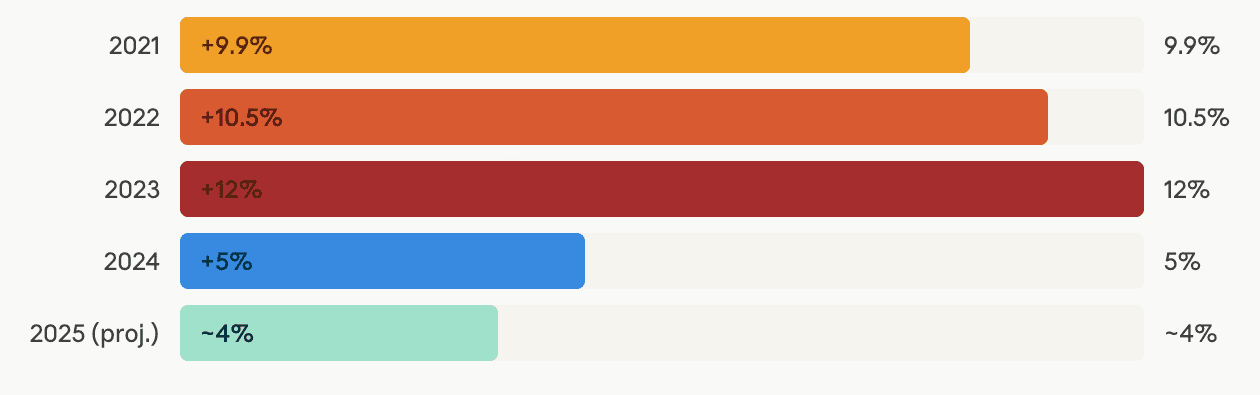
ANNUAL MOVING COST INCREASES
This isn't a matter of small fluctuations around a stable baseline. Since January 2020, the U.S. Consumer Price Index has risen by just over 25% across the economy. According to the International Association of Movers, the moving industry has faced disproportionate pressure during that period, with underlying operating costs rising by anywhere from 30% to 80% depending on the cost category.
To put that in a longer-term perspective: moving expenses that cost $200 in 1997 would cost roughly $411 today, according to U.S. Bureau of Labor Statistics data, an average inflation rate of 2.61% per year, slightly outpacing overall CPI.
The post-pandemic period amplified these trends sharply. Moving costs surged 12% in 2023 alone, before moderating to around 5% growth in 2024. Even at that slower pace, prices are still climbing.
Labor Is Driving Costs Up, Not Just Fuel
 Fuel surcharges |  Packing materials |
 Labor shortages |  2025 tariffs |
Beyond fuel, the bigger structural driver of rising quotes is labor. Moving companies rely on trained crews for packing, loading, transport, and delivery. The workforce data across most service industries has shown sustained upward pressure on wages and moving is no exception.
When it becomes more expensive to hire and retain skilled movers, that cost gets built into every estimate. A company quoting you today is pricing against what it costs them to staff a crew on your actual move date. If their labor costs rise before then, the difference has to come from somewhere.
The Type of Quote Matters More Than Ever
Not all moving estimates are equal, and in a volatile pricing environment, the distinction has real consequences:
A binding estimate locks in the total price based on the agreed scope. What you're quoted is what you pay, as long as the job doesn't change.
A non-binding estimate is a projection. The final bill is based on the actual weight and services at the time of the move, which can be higher than what you were shown.
In stable markets, most people don't worry about this distinction. Right now, it's the difference between financial certainty and an unwelcome surprise on moving day.
2025 Has Added New Pressure: Tariffs
The relocation cost picture in 2025 has a new complicating factor: tariffs on imported goods. Packing materials rely heavily on supply chains affected by trade policy. As import costs rise on these materials, moving companies absorb the increases and eventually pass them on.
Industry analysts have flagged this as a reason relocation policies may need recalibration this year, particularly for corporate moves where flat lump-sum structures are common. April 2025's CPI showed a 2.3% annual increase in headline inflation, with forecasts suggesting tariff impacts could push that toward 4% before year-end.
What This Means If You're Planning a Move
Get your quote as close to your move date as possible. The further out you book, the more exposure you have to price drift. For long-distance moves, six to eight weeks of lead time is recommended for booking, but aim to refresh your quote if circumstances change.
Always ask for a binding estimate. If you need price certainty, make sure the written documentation guarantees it. Read the terms for what constitutes a change to scope, which could invalidate the binding price.
Compare at least three quotes. Use early estimates as a baseline, not a commitment. The spread between providers often reflects differences in how they've priced fuel and labor assumptions.
Ask specifically about fuel surcharges. Request that this appears as a separate line item, and ask how it's calculated and when it resets. Any reputable company will answer this clearly.
Plan off-peak if you can. Peak moving season runs from May through August. Moving in the fall or winter typically means lower demand, better availability, and pricing that reflects less competitive pressure on crews and trucks.
The Bottom Line
A moving quote is a snapshot, not a contract. In a cost environment shaped by persistent inflation, tight labor markets, fuel volatility, and trade policy uncertainty, that snapshot expires faster than it used to.
The households that navigate this best aren't the ones who find the lowest number, they're the ones who understand what's in the number, when it was captured, and how to lock it in before it changes.
Not sure if your quote is reliable? Get matched with vetted movers who offer transparent, up-to-date pricing.



Jetzt starten
Mehr davon